
History Behind the Golden Triangle: Why Delhi, Agra, and Jaipur Matter
Delhi, Agra and Jaipur are often sold as a convenient sightseeing circuit. The map makes a neat triangle, the road connections are practical, and the photographs look irresistible. Yet geography alone does not explain why these three cities belong together.
The deeper connection is power. For centuries, rulers used Delhi to command the northern plains, Agra to display imperial wealth and Jaipur to protect Rajput interests through fortification, trade, diplomacy and careful planning. The cities competed, cooperated and borrowed ideas from one another.
This history explains why a Golden Triangle Tour India feels more complete than three unrelated city breaks. The route moves through the Delhi Sultanate, Mughal expansion, Rajput statecraft, colonial rule and modern India—without requiring a flight between every chapter.
Quick History Guide
Why Do Delhi, Agra and Jaipur Form India’s Golden Triangle?
The three cities form a triangle on the map, but their historical importance comes from the way they controlled government, trade, military routes, royal culture and architecture across North India.
The historical connection
Three Cities, Three Roles
Why Jaipur completes the story
- Rajput military and diplomatic strength
- A planned capital designed for trade
- Scientific ambition at Jantar Mantar
- A living link between palace and bazaar culture
Best history-focused pace
Five to Seven Days
What the route reveals
- Sultanate foundations in Delhi
- Mughal ambition in Agra
- Rajput resilience in Amber and Jaipur
- How trade and roads shaped every capital
The Bigger Story
Why the History Behind the Golden Triangle Matters
A traveller can enjoy the Taj Mahal without knowing a single Mughal emperor. You can also admire Amber Fort without understanding Rajput politics. The buildings are impressive enough to stand on their own.
History changes the experience, though. Once you know why capitals moved, why rulers married into rival families, why forts contain delicate palaces and why planned bazaars mattered, the route stops feeling like a checklist.
The Golden Triangle becomes a story about control. Delhi offered access to the northern plains and major roads. Agra sat close to rich agricultural land and the Yamuna. Amber protected a hill kingdom, while Jaipur later created a more practical capital for commerce and administration.
It is also a story about adaptation. New rulers rarely started with a blank page. They reused skilled craftsmen, local building methods, older roads, earlier settlements and political alliances. That is why the architecture refuses to fit into one simple box.
What Makes This Route Different?
Many heritage circuits focus on one dynasty or one region. The Golden Triangle compresses several political cultures into a short road journey. A traveller can compare Sultanate monuments, Mughal gardens, imperial forts, Rajput palaces, observatories, colonial avenues and modern national landmarks within a single week.
Name and Geography
Why Is It Called the Golden Triangle?
Delhi, Agra and Jaipur create a rough triangular shape on the map. Delhi sits to the north, Agra to the southeast and Jaipur to the southwest. Road distances vary by route, but the full circuit is commonly described as roughly 700 to 750 kilometres.
The word “golden” is tourism language rather than an ancient historical name. It reflects the concentration of famous monuments, royal cities, markets, hotels and cultural experiences found along the route.
The name works because the journey is both practical and visually rich. Delhi has major transport connections. Agra is close enough for a road or train transfer. Jaipur completes the circuit with forts, palaces and a distinctive urban identity.
| City | Historical role | Geographical advantage | What travellers see today |
|---|---|---|---|
| Delhi | Political and administrative centre | Access to northern plains and major routes | Qutb complex, Humayun’s Tomb, Red Fort, Old Delhi, New Delhi |
| Agra | Mughal imperial and architectural centre | Yamuna River and fertile Doab region | Taj Mahal, Agra Fort, Mughal gardens, nearby Fatehpur Sikri |
| Jaipur | Rajput capital, trading city and scientific centre | Gateway between plains and Rajasthan | Amber Fort, City Palace, Jantar Mantar, Hawa Mahal and bazaars |
Delhi Through the Centuries
Delhi: North India’s Political Nerve Centre
Delhi has repeatedly attracted rulers because of its location. It offered access to the Indo-Gangetic plains, routes towards Punjab and Central Asia, and connections eastward into the subcontinent.
The city was not one continuous capital built by one dynasty. It developed through multiple fortified settlements, courtly centres and later colonial planning. That layered character is exactly why Delhi can feel confusing on a first visit.

The Delhi Sultanate and a New Political Order
The Delhi Sultanate established the city as the centre of a powerful state stretching far beyond its immediate surroundings. Early rulers used forts, mosques, gateways and minarets to announce authority while relying on local materials and craftsmen.
The Qutb complex captures that early period better than almost any other site. Qutb Minar dominates the skyline, but the surrounding mosque, tombs, gateways, inscriptions and earlier Iron Pillar make the complex historically richer than a single tower photograph suggests.
The monuments also show experimentation. Builders worked through questions of arches, domes, carved surfaces and structural traditions. The result was not a neat replacement of one architectural culture by another. It was a long period of adaptation.
Power Changes, but Delhi Remains Valuable
Dynasties rose and fell. Invasions damaged the city. Courts shifted. Yet Delhi remained difficult to ignore because roads, agricultural regions, military routes and symbolic authority continued to pull rulers back.
This repeated destruction and rebuilding explains why the city contains ruins that appear isolated today. A broken wall beside traffic may once have belonged to a much larger political world.
The Mughals and the Return to Delhi
Babur’s victory in 1526 opened the Mughal period, although control remained unstable during the early decades. Humayun lost and regained power, and his tomb later became one of Delhi’s defining monuments.
Humayun’s Tomb introduced a monumental garden-tomb design that shaped later Mughal architecture. Its formal garden, raised platform, symmetrical planning and combination of red sandstone with white marble prepared visitors for ideas developed more fully in Agra.
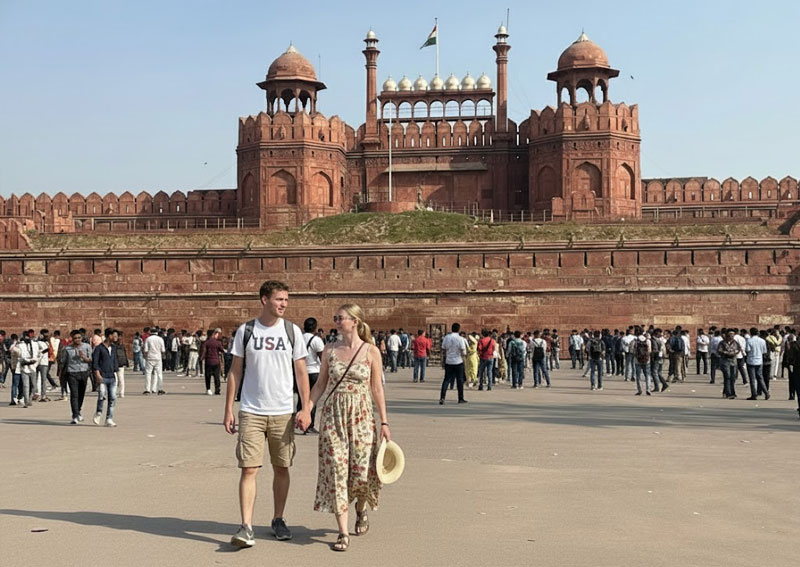
Shah Jahan eventually created Shahjahanabad, the imperial city associated with the Red Fort and Jama Masjid. The fort was not only a defensive structure. It was a palace, administrative centre and stage for imperial ceremony.
Old Delhi as a Living Historical Space
Chandni Chowk and the lanes around Jama Masjid remain busy commercial areas. The noise can feel overwhelming, especially after the controlled geometry of a Mughal garden.
That contrast is useful. Historical capitals were not quiet museums. They were full of merchants, animals, food sellers, officials, craftsmen, pilgrims and arguments over prices. Some things change less than travel brochures suggest.
British New Delhi and the Modern Capital
The British decision to move the imperial capital from Calcutta to Delhi in the early twentieth century gave the city another political layer. New Delhi’s broad avenues, government buildings and ceremonial spaces expressed a different kind of authority.
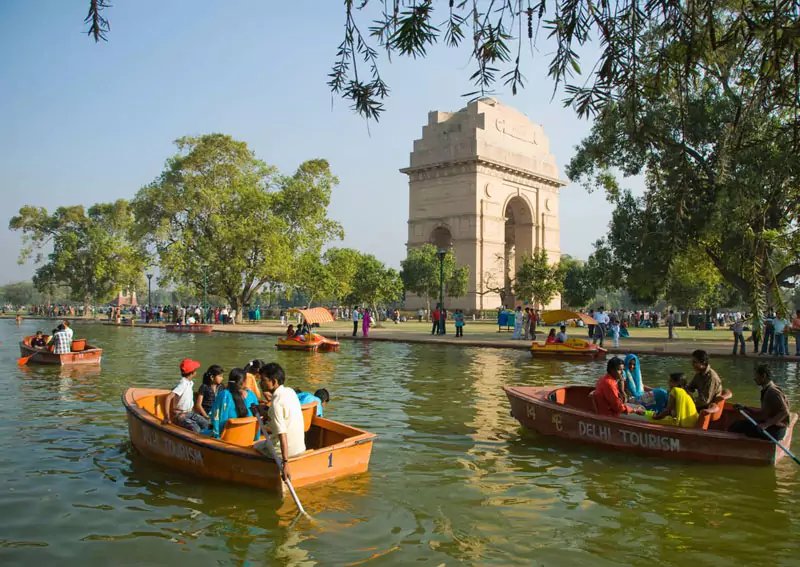
After independence, the same district became the administrative heart of modern India. India Gate, Parliament, Rashtrapati Bhavan and the surrounding avenues now belong to a national capital rather than a colonial one.
Best Way to Understand Delhi’s History
Do not try to read Delhi in strict geographical order. Group sites by historical story. Visit Qutb Minar and Humayun’s Tomb for the Sultanate-to-Mughal transition, Red Fort and Old Delhi for Shah Jahan’s capital, and New Delhi for the colonial and modern chapters.
The Mughal Heartland
Agra: The Empire’s Architectural Workshop
Agra’s reputation is often reduced to the Taj Mahal. That sells the city short. The Taj makes more sense after you understand the fort, the river, the court and the earlier experiments at Fatehpur Sikri.
The city gained importance before the Mughals, but Mughal rulers transformed it into an imperial centre. Its location beside the Yamuna and close to productive agricultural regions helped support a wealthy court.
Agra Fort: Military Strength Becomes Palace Life
Akbar rebuilt Agra Fort in red sandstone during the sixteenth century. The massive walls protected a complex that combined military, administrative and residential functions.
Inside, the fort changes character. Strong gates and ramparts lead towards courtyards, halls and palace buildings. Later Mughal additions brought more marble and lighter decorative work.
This mixture lets travellers compare rulers through architecture. Akbar’s spaces often feel solid and experimental. Shah Jahan’s additions appear more refined, with marble surfaces and carefully controlled views.
The view towards the Taj Mahal is one of the fort’s most memorable moments. Popular stories connect it with Shah Jahan’s final years under Aurangzeb. A careful guide can explain where documented history ends and romantic storytelling begins.
The Taj Mahal: Memory Turned into Imperial Design
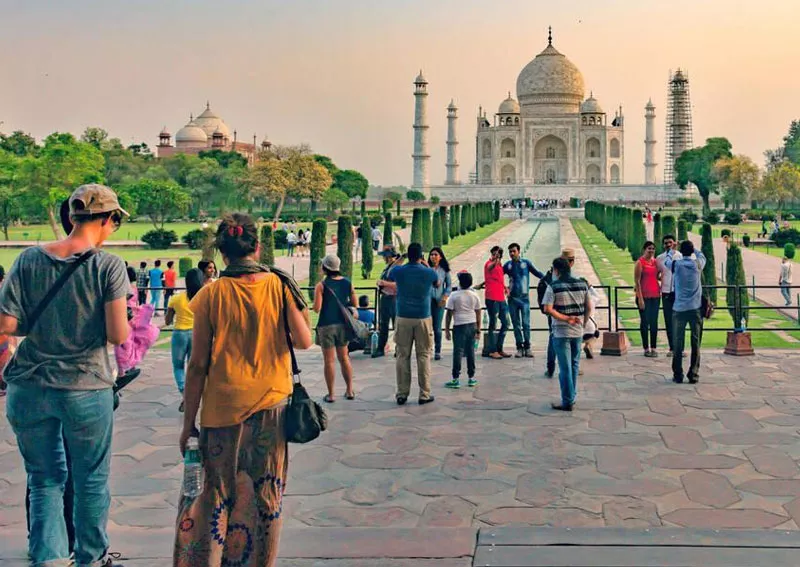
Shah Jahan commissioned the Taj Mahal after the death of Mumtaz Mahal. The monument is commonly presented as a love story, and that emotional reading is understandable.
It was also an imperial project. The complex required skilled designers, stone workers, calligraphers, inlay specialists, builders, transport networks and financial resources from across the empire.
The white marble mausoleum receives most of the attention, but the full design includes the gateway, gardens, water channels, mosque, matching building, river edge and carefully managed approach.
Symmetry creates calm, but the design is not mechanically repetitive. Calligraphy changes scale, minarets frame the mausoleum, floral inlay rewards close inspection and the marble reacts to weather throughout the day.
A Taj Mahal Day Tour From Delhi can cover the monument and Agra Fort, but travellers interested in history benefit from staying overnight. Sunrise becomes easier, and the city no longer feels like a race against the expressway.
Fatehpur Sikri: Akbar’s Planned Capital
Fatehpur Sikri was developed by Akbar as a new royal centre near the residence of the Sufi saint Salim Chishti. The palace and religious areas reveal an ambitious experiment in urban planning, court life and imperial symbolism.
The red sandstone buildings combine courtyards, pavilions, audience spaces and private areas. The Jama Masjid, tomb of Salim Chishti and Buland Darwaza form a powerful sacred and ceremonial zone.
The court remained there for a relatively short period. Water supply, military priorities and changing political needs are all discussed when explaining the move away from the capital.
Calling it an abandoned “ghost city” makes a good headline but simplifies the reality. The protected complex survives beside active settlements and continuing religious life.
How Agra Connects the Mughal Story
Visit Agra Fort before or after the Taj Mahal, then stop at Fatehpur Sikri on the road to Jaipur. The three sites explain royal power, funerary architecture and Akbar’s attempt to create an ideal capital.
Rajput Strategy
Jaipur: Resilience, Diplomacy and Scientific Ambition
Jaipur completes the Golden Triangle because it offers a political story different from Delhi and Agra. Rajput rulers did not simply stand outside Mughal power. They fought, negotiated, married, served, resisted and protected their own interests in different periods.
The Kachwaha rulers of Amber built influence through a combination of military service and diplomacy. Their relationship with the Mughal court brought opportunities, wealth and political complexity.
Amber Fort: A Hill Capital Before Jaipur

Amber rises above Maota Lake in a position chosen for defence, visibility and control. Fortified walls follow the surrounding ridges, creating a much larger landscape than the main palace alone.
Inside, the sequence shifts from military approach to royal display. Gates open into courtyards, public halls, private apartments, temples and the mirror-covered Sheesh Mahal.
The contrast matters. A fort was not just a place to survive an attack. It was also a court where rulers received visitors, performed ceremonies and managed family life.
Water systems, shaded spaces, thick walls and seasonal planning helped make palace life possible in Rajasthan’s climate. These practical details are easy to miss when everyone is queuing for the same mirror-room photograph.
Why Sawai Jai Singh II Built Jaipur
By the early eighteenth century, Amber’s hill setting created limits for a growing court and commercial centre. Sawai Jai Singh II founded Jaipur in 1727 as a planned capital on flatter land.
The city used a grid of broad streets, defined market areas and organised blocks. Planning supported administration, movement, craft production and trade.
Jaipur’s famous pink appearance belongs to a later chapter, associated with preparations for a royal visit in the nineteenth century. The colour became part of the city’s identity and is now protected within the historic core.
City Palace, Hawa Mahal and the Walled City
City Palace developed as the royal centre of Jaipur. Its courtyards, gates, museums and later additions reflect changing tastes and political circumstances.
Hawa Mahal was added in 1799. Its many screened windows allowed royal women to observe processions and street life while remaining behind the façade.
The building is visually famous, but its location matters just as much. It faces the market street and belongs to Jaipur’s relationship between palace, procession and commerce.
Jantar Mantar and a Ruler Who Studied the Sky
Sawai Jai Singh II was deeply interested in astronomy. Jantar Mantar contains large masonry instruments designed to observe time and celestial movement.
Without explanation, the site can look like a collection of oversized geometric sculptures. With a knowledgeable guide, it becomes evidence of Jaipur’s scientific and intellectual ambition.
The observatory also reminds visitors that Indian courts supported more than warfare and palace decoration. Mathematics, calendars, astronomy and administration were linked to practical government.
Best Way to Read Jaipur
Begin at Amber Fort to understand the older hill capital. Then enter the walled city for City Palace, Jantar Mantar, Hawa Mahal and the bazaars. The journey from Amber to Jaipur is itself the historical story.
Connected Capitals
How Delhi, Agra and Jaipur Influenced One Another
The three cities were not sealed worlds. Rulers, soldiers, merchants, craftsmen, diplomats and family networks moved between them.
Mughal political culture shaped Rajput courts, while Rajput military leaders became important figures within the Mughal state. Architecture travelled with builders and patrons. Decorative ideas crossed regional lines.
Delhi’s earlier monuments influenced the development of Indo-Islamic forms. Humayun’s Tomb helped establish the garden-tomb tradition later perfected at the Taj Mahal.
Agra’s imperial workshops developed stone carving, marble inlay and courtly design. Rajput palaces absorbed and reworked Mughal ideas without losing their own spatial traditions.
Jaipur’s planned streets and market organisation belonged to a different political moment, but they also reflected lessons learned from older capitals. Rulers needed ceremonial spaces, defensive awareness, trade revenue and efficient administration.
What Travelled Between Courts
- Architects and stone workers
- Military knowledge
- Marriage alliances
- Textiles, jewellery and luxury goods
- Administrative methods
- Religious and intellectual ideas
What Stayed Distinct
- Local building materials
- Regional palace traditions
- Fortified landscapes
- Temple and court practices
- Market specialisations
- Different relationships with terrain
Historical Sequence
Golden Triangle History Timeline
The route covers centuries of political change. Exact historical periods overlap, but this simplified timeline helps travellers connect the monuments in a sensible order.
Early Foundations
Ancient Settlements and Trade Routes
The region around Delhi, the Yamuna and Rajasthan was connected to older settlements, agricultural zones and long-distance trade before the famous capitals took their later form.
12th–16th Centuries
The Delhi Sultanate
Delhi developed as the centre of successive Sultanate dynasties. The Qutb complex and later fortified settlements reflect political change, new patrons and architectural adaptation.
1526
The Mughal Beginning
Babur’s victory at Panipat opened the Mughal period, although the early empire remained unstable and contested.
Mid-16th Century
Akbar and Agra
Akbar strengthened Mughal rule, rebuilt Agra Fort and created Fatehpur Sikri. Rajput alliances became central to imperial politics.
17th Century
Shah Jahan’s Imperial Style
The Taj Mahal, marble additions in Agra Fort and the creation of Shahjahanabad in Delhi represent the confidence and resources of the Mughal court.
Late 17th–18th Centuries
Changing Mughal-Rajput Relations
Imperial expansion and political tensions reshaped alliances. Regional powers became increasingly important as Mughal control weakened.
1727
Jaipur Is Founded
Sawai Jai Singh II created a planned capital better suited to administration, trade and the needs of a growing state.
18th–19th Centuries
Regional Competition and British Expansion
Courts adjusted to shifting alliances, warfare and the growing power of the East India Company and later British government.
1857
The End of Mughal Sovereignty
The uprising and its suppression ended the symbolic rule of the last Mughal emperor and transformed Delhi’s political landscape.
1911–1947
New Delhi and Independence
The British built a new imperial capital. After 1947, Delhi became the capital of independent India, and the Red Fort gained renewed national symbolism.
Modern Era
Tourism, Conservation and Living Heritage
The three cities now balance heritage protection with urban growth, pollution, traffic, local livelihoods and millions of visitors.
Reading the Buildings
How Architecture Changes Across the Golden Triangle
The route is often described using broad labels such as Mughal, Islamic or Rajput. Those labels are useful starting points, not complete explanations.
Buildings changed with patronage, available materials, climate, craftsmen and political purpose. A tomb, fort, palace and observatory solve different problems even when built under the same ruler.
| Site | Main historical idea | Material impression | What to notice |
|---|---|---|---|
| Qutb complex | Sultanate authority and adaptation | Red and buff sandstone | Carving, inscriptions, reused forms and changing construction methods |
| Humayun’s Tomb | Monumental garden-tomb planning | Red sandstone with white marble | Charbagh layout, symmetry, elevated platform and dome |
| Red Fort, Delhi | Imperial ceremony and palace administration | Sandstone walls and marble interiors | Movement from public to private spaces |
| Agra Fort | Military power transformed into royal residence | Red sandstone and later marble | Differences between Akbar’s and Shah Jahan’s periods |
| Taj Mahal | Memory, empire and controlled symmetry | White marble and inlay | Gateway framing, garden axis, calligraphy and surface detail |
| Fatehpur Sikri | Planned imperial capital | Red sandstone | Courtyards, pavilions and the relationship between palace and mosque |
| Amber Fort | Defence combined with court life | Sandstone, marble, plaster and mirror work | Hill setting, water management, gates and palace sequence |
| Jaipur City | Urban planning and commercial organisation | Painted façades and masonry streetscape | Street grid, market specialisation, gates and public squares |
| Jantar Mantar | Astronomy expressed through architecture | Masonry instruments | Scale, shadow, orientation and mathematical purpose |
Movement and Wealth
How Trade Routes and Geography Created Power
Capitals require more than palaces. They need food, taxes, transport, markets, water, soldiers and reliable communication.
Delhi benefited from routes linking the Punjab, northern plains and regions further east. Control of movement helped rulers collect revenue and respond to military threats.
Agra stood beside the Yamuna and close to fertile lands between major rivers. Agricultural income and river connections supported the Mughal court and its building projects.
Jaipur occupied a useful position between northern plains and Rajasthan’s trading networks. Its planned markets supported merchants dealing in textiles, gems, metalwork, crafts and luxury goods.
The roads between the cities also carried political influence. Royal marriages, military campaigns, diplomatic missions and craft traditions moved along the same broad corridors used by traders.
History Is Not Only About Kings
Royal monuments dominate travel itineraries because they survive dramatically. The cities also depended on farmers, transport workers, artisans, water carriers, traders, builders and domestic labour. A palace without those people would have been a very expensive empty shell.
From Empire to Nation
Colonial Rule, Independence and the Modern Golden Triangle
British expansion changed the political relationships that had shaped Delhi, Agra and Jaipur. Delhi eventually became the imperial capital, Agra developed under colonial administration and Jaipur continued as a princely state under indirect rule.
The events of 1857 were especially important for Delhi and Agra. After the uprising, the British removed the last Mughal emperor and altered many historic spaces.
In 1911, the British announced the transfer of the imperial capital to Delhi. The new administrative district was designed on a monumental scale, separate in character from Shahjahanabad.
Independence transformed the meaning of these spaces. The Red Fort became a central symbol of national sovereignty. New Delhi became the seat of democratic government.
Jaipur joined independent India and later became the capital of Rajasthan. Its palaces, markets and planned core now serve residents, government, tourism and heritage conservation at the same time.
Agra’s monuments became global tourism icons. That success brings income but also pressure from crowds, pollution, traffic and commercial development.
Preservation Is an Ongoing Process
Conservation is not a one-time repair. Stone surfaces weather, air pollution affects monuments, water systems change and heavy visitor movement damages delicate areas.
Modern preservation involves cleaning, structural monitoring, visitor controls, documentation and restrictions on traffic or industrial activity near sensitive sites.
There is always a balance to manage. A protected city cannot simply stop living. Residents need homes, transport and jobs, while monuments require space and care.
Travel in Historical Order
Best 5-Day History-Focused Golden Triangle Itinerary
Day 1: Delhi Foundations
Visit Qutb Minar and Humayun’s Tomb. The day introduces the transition from Sultanate Delhi to the early Mughal garden-tomb tradition.
Day 2: Imperial Delhi
Explore the Red Fort, Jama Masjid and Old Delhi. Add a New Delhi drive before travelling to Agra in the evening.
Day 3: Mughal Agra
Visit the Taj Mahal at sunrise and Agra Fort later in the morning. Use the afternoon for a garden viewpoint or a slower local experience.
Day 4: Akbar to the Rajputs
Stop at Fatehpur Sikri on the road to Jaipur. Continue towards Amber and use the evening for orientation rather than forcing another major visit.
Day 5: Amber and Planned Jaipur
Explore Amber Fort, Jantar Mantar, City Palace, Hawa Mahal and part of the walled city before departure.
Seven-Day Slower Historical Route
- Day 1: Delhi arrival and New Delhi orientation.
- Day 2: Qutb Minar, Humayun’s Tomb and nearby heritage areas.
- Day 3: Red Fort, Jama Masjid, Chandni Chowk and Old Delhi walk.
- Day 4: Drive or train to Agra, followed by Agra Fort and Mehtab Bagh.
- Day 5: Taj Mahal at sunrise, then Fatehpur Sikri and Jaipur transfer.
- Day 6: Amber Fort, Jal Mahal viewpoint and Jaipur royal core.
- Day 7: Jantar Mantar, walled-city walk, markets and departure.
Practical Advice
How to Plan a Golden Triangle History Tour
Choose Guides for the Complicated Sites
A guide adds the most value where buildings have multiple phases or unclear functions. Qutb Minar, Red Fort, Agra Fort, Fatehpur Sikri, Amber Fort and Jantar Mantar deserve interpretation.
Ask about the guide’s language, city licence, duration and price before beginning. A guide who rushes through dates without explaining the site is simply a talking calendar.
Do Not Overload Each Day
Forts and historic cities involve real walking. Security checks, traffic and meal breaks also consume time.
Two major sites plus one lighter experience usually create a better day than five monuments and a driver waiting with the engine running.
Use the Route Efficiently
Travel Delhi to Agra to Jaipur to avoid unnecessary backtracking. Fatehpur Sikri belongs naturally on the Agra-to-Jaipur road.
A private car offers the easiest historical sequence, particularly for families and first-time visitors. Trains work well between Delhi and Agra, but local transfers still need planning.
Stay Close to the First Morning Visit
A Delhi hotel location should match the first day’s sightseeing. In Agra, easy access to the Taj helps with sunrise. In Jaipur, decide whether you prefer the atmosphere of the old city or a quieter hotel outside it.
History Tour Booking Checklist
- Exact hotel names and locations
- Private vehicle type and luggage capacity
- Guide service in Delhi, Agra and Jaipur
- Taj Mahal weekday and entry timing
- Fatehpur Sikri stop during transfer
- Monument ticket inclusions
- Tolls, parking and driver allowance
- Daily walking expectations
- Time for Old Delhi and Jaipur markets
- Optional shopping stops clearly identified
Avoid Easy Errors
Common Mistakes When Explaining Golden Triangle History
Treating the Route as Only a Mughal Story
The Mughals shaped Delhi and Agra powerfully, but the route also includes the Delhi Sultanate, Rajput courts, colonial planning and modern India.
Calling Every Red Fort the Same Place
Delhi’s Red Fort and Agra Fort are different monuments with different histories. Their similar materials and popular names cause more confusion than they should.
Reducing the Taj Mahal to a Love Story
The emotional story matters, but the monument also reflects imperial resources, specialised labour, landscape planning and court culture.
Describing Jaipur as Only the Pink City
Jaipur’s colour is memorable. Its planned markets, astronomical observatory and relationship with Amber explain why the city matters historically.
Forgetting Trade and Ordinary Workers
Empires needed taxation, agriculture, roads, merchants and craftspeople. Monumental history becomes more believable when the economy behind it is visible.
Believing Every Popular Legend
Guides sometimes repeat stories because they are entertaining. Ask whether a claim is documented, debated or simply part of local folklore.
Beyond Royal Names
The People Who Actually Built and Sustained These Capitals
Golden Triangle history is usually told through famous rulers because their names appear in inscriptions, court histories and monument labels. Yet no emperor lifted the stone for his own fort, cut marble flowers into a tomb or carried water through a palace.
Delhi, Agra and Jaipur depended on large communities of builders, stone cutters, calligraphers, painters, metalworkers, gardeners, textile makers, cooks, guards, clerks, merchants and transport workers. Their labour gave royal ambition a physical form.
Craft Skills Moved with Political Power
When courts changed location, skilled workers often followed opportunity. A patron planning a fort or tomb needed people who understood quarrying, geometry, carving, lime plaster, drainage and decorative work.
That movement helps explain why related techniques appear across distant sites. It does not mean every monument used one identical workforce. Local craftsmen adapted courtly ideas to regional materials and traditions.
Markets Kept the Capitals Alive
Royal courts attracted merchants because thousands of residents needed grain, cloth, animals, fuel, metal, paper and luxury goods. Chandni Chowk, Agra’s commercial quarters and Jaipur’s planned bazaars were economic systems, not colourful backgrounds for visitors.
Jaipur’s specialised markets are especially useful for understanding this relationship. Different streets developed reputations for jewellery, textiles, metalwork and everyday goods. Planning made trade easier to organise and tax.
Women Were Part of Political and Courtly Life
Women appear less often in simplified timelines, but royal marriages could shape alliances, succession and access to court. Queens and princesses managed households, supported religious institutions, commissioned buildings and influenced family politics.
Hawa Mahal is often explained only as a viewing screen for royal women. That is part of the story, but the building also belongs to a larger palace and street system shaped by procession, privacy, climate and social convention.
Living Heritage Still Depends on Local Communities
Today, guides, photographers, drivers, shopkeepers, hotel workers and craftspeople continue to earn livelihoods from the historical route. Conservation policies affect them directly.
Responsible tourism should protect monuments without pretending that heritage exists separately from local life. A clean photograph may hide a crowded market, but the market is often part of the history.
Compare the Capitals
How Political Power Looked Different in Delhi, Agra and Jaipur
Power was not expressed in one universal way. Each city used architecture and planning according to its political situation.
Delhi: Authority Through Capitals and Ceremony
Delhi’s rulers repeatedly created new fortified centres. Walls, gateways and audience spaces controlled movement and made hierarchy visible.
The Red Fort’s ceremonial route separated ordinary access from imperial presence. New Delhi later used long avenues and government buildings to produce a different but equally deliberate image of authority.
Agra: Power Through Courtly Refinement
Agra Fort protected the court, but its river-facing palaces also displayed comfort and cultivated taste. The Taj Mahal extended that display into funerary architecture.
Visitors often read white marble as pure beauty. In its own period, rare material, skilled labour and perfect maintenance also communicated resources that few patrons could command.
Jaipur: Power Through Adaptation
Amber’s ridge position projected military security. Jaipur’s grid projected administrative confidence and commercial ambition.
The move from hill fort to planned city did not reject the past. It allowed the state to respond to new economic and political conditions.
| City | Main expression of power | Representative space | Visitor lesson |
|---|---|---|---|
| Delhi | Control of capitals and public ceremony | Red Fort and New Delhi avenues | Political authority needs visibility and access control |
| Agra | Imperial wealth and artistic refinement | Agra Fort and Taj Mahal | Architecture can turn resources into lasting symbolism |
| Jaipur | Defence, diplomacy and organised commerce | Amber Fort and the walled city | Survival may depend on adaptation rather than simple resistance |
Fact and Folklore
Popular Golden Triangle Stories That Need Context
Great monuments attract great stories. Some are documented, some are debated and others survive because they are too entertaining to disappear.
Did Shah Jahan Plan a Black Taj Mahal?
The idea of a black marble mausoleum across the Yamuna is widely repeated. Archaeological and documentary evidence does not support the dramatic version often told to tourists.
Mehtab Bagh remains valuable as part of the river landscape, even without a secret black twin.
Was Shah Jahan Imprisoned With a Perfect Taj View?
Shah Jahan spent his final years under the authority of Aurangzeb in Agra Fort. The fort contains river-facing spaces with Taj Mahal views.
The emotional image of an ageing emperor staring constantly at the tomb is powerful, but details are often embellished in popular narration.
Was Fatehpur Sikri Abandoned Only Because of Water?
Water difficulties are frequently offered as the single explanation. Historians also consider changing military priorities, court movement and political strategy.
Capital cities can lose importance for several reasons at once. One neat cause is easier to remember, not necessarily more accurate.
Does One Candle Light the Entire Sheesh Mahal?
The mirror work at Amber Fort was designed to multiply light beautifully. Claims about one flame illuminating every surface are often theatrical.
The room remains impressive without needing a demonstration that risks smoke or damage.
Was Jaipur Always Pink?
Jaipur was planned in the eighteenth century, but the famous uniform pink association belongs strongly to nineteenth-century preparations for a royal visit.
The colour later became part of regulation and identity within the historic city.
Ask One Useful Question
When a guide tells a dramatic story, ask whether it comes from an inscription, a historical record, later tradition or local folklore. A good guide will not be offended by the question.
Deeper Travel
How History Lovers Can Get More From the Route
A history-focused trip does not require an academic degree or a notebook full of dates. It needs enough time to compare sites.
Choose One Question for Each City
In Delhi, ask why rulers kept returning. In Agra, ask how Mughal power became architecture. In Jaipur, ask how Rajput rulers adapted to changing political conditions.
These questions create a thread stronger than memorising every succession dispute.
Compare Similar Spaces
Look at public audience halls in Delhi and Agra. Compare Humayun’s Tomb with the Taj Mahal. Notice how Amber Fort and Agra Fort both combine security with palace life.
Comparison turns passive sightseeing into active observation.
Leave Time for Small Details
Large monuments announce themselves immediately. Historical understanding often hides in water channels, worn thresholds, inscriptions, ventilation screens and changes in stone.
Spend ten quiet minutes looking before reaching for the phone. The monument will survive without another instant wide-angle photograph.
Use Museums Selectively
Site museums can add maps, objects and historical context, but museum access and opening arrangements change. Choose the collection that supports your main interest rather than visiting every gallery from duty.
Read Before and After the Trip
A short introduction before travel prevents every name from sounding new. Reading again after the journey helps physical spaces make sense.
Photographs become more useful once you can connect a courtyard to its function rather than remembering only that the weather was hot.
Timing the Experience
Best Time and Daily Rhythm for a Historical Tour
Weather changes how long travellers can concentrate. History becomes surprisingly difficult when everyone is thirsty and the nearest shaded bench is occupied.
October to March
Cooler days suit forts, gardens and old-city walks. December and January may bring fog, cold mornings and poor visibility in Delhi and Agra.
Peak season also means higher hotel prices and more crowded monument entrances.
April to June
Heat demands early starts. Use the middle of the day for lunch, hotel rest or indoor museums.
Amber Fort, Fatehpur Sikri and exposed courtyards become tiring quickly. A technically possible schedule may still be a bad schedule.
July to September
Monsoon brings humidity, greener landscapes and occasional heavy rain. Stone can become slippery and road travel less predictable.
Carry light rain protection and keep electronics secure.
A Better Daily Pattern
- Begin with the largest outdoor monument near opening time.
- Use late morning for a second major site.
- Take a proper lunch break rather than eating in the vehicle.
- Keep markets, museums or viewpoints for later afternoon.
- Leave one evening free every two or three days.
Plan a Historical Journey
Build a Private Delhi, Agra and Jaipur History Tour
Share your dates, group size, hotel preference and the periods that interest you most. A practical route can combine major monuments, local guides and enough time to understand each city without turning the journey into a monument marathon.
- Private air-conditioned vehicle and professional driver
- Local guides in Delhi, Agra and Jaipur
- Sunrise Taj Mahal planning
- Fatehpur Sikri transfer stop
- Budget, mid-range and luxury hotel options
- Flexible airport and railway station pickups
Common Questions
Frequently Asked Questions About Golden Triangle History
These answers explain the historical connection between Delhi, Agra and Jaipur and how travellers can experience the route in a sensible order.
Why are Delhi, Agra and Jaipur called the Golden Triangle?
The three cities form a rough triangle on the map and contain a high concentration of famous forts, tombs, palaces, markets and cultural experiences. “Golden Triangle” is a modern tourism term rather than an ancient historical name.
What is the historical connection between Delhi, Agra and Jaipur?
Delhi served repeatedly as a political capital, Agra became a major Mughal court and architectural centre, and Amber–Jaipur represented Rajput military strength, diplomacy, trade and planned urban development.
Which city is the oldest in the Golden Triangle?
Delhi has the longest and most layered history as a major political landscape, with older settlements and successive fortified cities. Agra and Amber also predate their best-known Mughal and Jaipur monuments.
Why was Delhi so important to rulers?
Delhi offered access to the northern plains, important military and commercial routes, productive regions and strong symbolic value as a seat of power.
Why did the Mughals choose Agra?
Agra’s Yamuna location, access to fertile agricultural lands and strategic position made it suitable for an imperial court. Mughal rulers transformed the city through forts, gardens, palaces and tombs.
Why was Jaipur built when Amber already existed?
Amber’s hill setting limited space for a growing court and commercial centre. Sawai Jai Singh II founded Jaipur on flatter land with planned streets, markets and administrative areas.
Is the Golden Triangle mainly a Mughal route?
No. Mughal history is central, especially in Agra, but the route also includes Delhi Sultanate monuments, Rajput courts, colonial New Delhi and modern national history.
How many days are best for a history-focused Golden Triangle tour?
Five days can cover the major sites at a fast pace. Six or seven days is better for guided visits, Old Delhi, Jaipur’s markets and a less rushed understanding of the route.
What is the best historical order for visiting the cities?
Delhi to Agra to Jaipur works well. It moves from Sultanate and Mughal Delhi to imperial Agra, then towards Fatehpur Sikri, Amber and planned Jaipur.
Which monuments best explain the route’s history?
Qutb Minar, Humayun’s Tomb, Red Fort, Agra Fort, Taj Mahal, Fatehpur Sikri, Amber Fort, Jantar Mantar and Jaipur’s walled city provide the clearest historical sequence.
Do I need a guide at every monument?
No. A guide is most valuable at complex sites such as Qutb Minar, Red Fort, Agra Fort, Fatehpur Sikri, Amber Fort and Jantar Mantar. Confirm credentials, language and price before starting.
Can the Golden Triangle be completed in three days?
Three days can cover a few headline attractions, but it does not provide enough time for a meaningful historical journey. Transfers, traffic and security checks leave little room for detailed visits.
What should history lovers avoid when planning?
Avoid too many monuments in one day, compulsory shopping stops, vague guide arrangements and hotel locations that require long daily detours.
Is Jaipur connected to Mughal history?
Yes. The Kachwaha rulers of Amber had important military, political and family relationships with the Mughal court. Jaipur later developed as a distinct planned Rajput capital.
Why does the route remain important today?
The Golden Triangle connects major heritage sites with living cities, modern transport and strong tourism infrastructure. It remains one of the clearest introductions to North India’s political and architectural history.
Final Historical Perspective
Why Delhi, Agra and Jaipur Still Matter
The Golden Triangle matters because each city answers a different question. Delhi shows why rulers repeatedly fought for political control. Agra reveals how Mughal emperors turned power into architecture. Jaipur explains how Rajput rulers protected their position through forts, alliances, trade, planning and science.
Together, the cities show that Indian history was not a straight line from one empire to another. It developed through competition, cooperation, adaptation and constant movement.
The best journey is not the one that collects the most photographs. It is the one that lets you recognise the shift from a Sultanate minaret to a Mughal garden tomb, from an imperial fort to a marble mausoleum, and from a hill capital to a planned commercial city.