
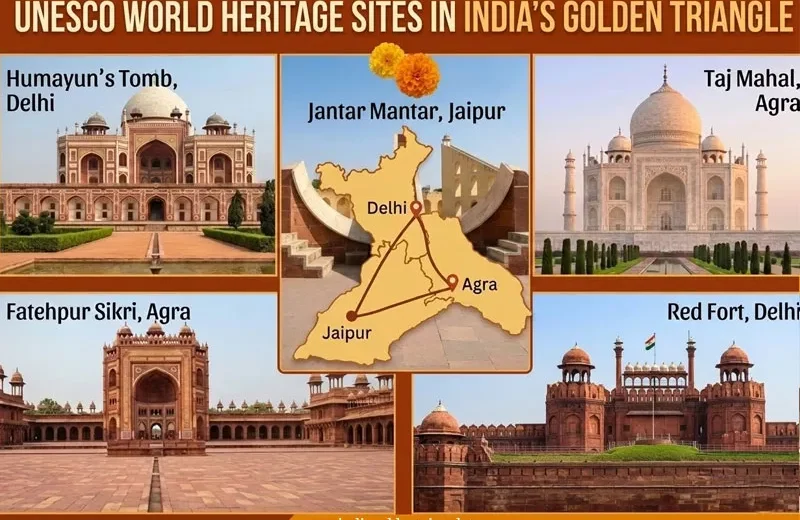
UNESCO World Heritage Sites in India’s Golden Triangle pack centuries of power, art, and engineering into one compact loop. This 720-kilometre circuit through Delhi, Agra, and Jaipur lets you stand inside sultanate mosques, Mughal palaces, Rajput forts, and astronomical observatories in as little as five to seven days. You move from 12th‑century minarets to 18th‑century science parks without ever leaving North India, making the Golden Triangle one of the world’s most efficient routes for heritage‑focused travel. Eight major UNESCO sites sit along well-maintained highways and rail lines, supported by strong tourism infrastructure, verified ticketing, and year‑round connectivity.
Why the Golden Triangle Is a UNESCO Hotspot
The Golden Triangle concentrates a rare mix of cultural, architectural, and scientific heritage in three cities that shaped North India’s history. Delhi showcases the early rise of Islamic rule and the flowering of Mughal power. Agra captures the zenith of imperial architecture and city building. Jaipur represents Rajput resilience, urban planning, and astronomical innovation. Together, they offer an accessible crash course in India’s past with clear signage, managed visitor flows, and active conservation projects.
Quick List of UNESCO Sites on the Route
- Qutub Minar and its Monuments, Delhi
- Humayun’s Tomb, Delhi
- Red Fort Complex, Delhi
- Taj Mahal, Agra
- Agra Fort, Agra
- Fatehpur Sikri, near Agra
- Jantar Mantar, Jaipur
- Jaipur City (Pink City / Historic Urban Ensemble, including City Palace–Hawa Mahal area)
Many travelers also add Keoladeo National Park in Bharatpur as a natural UNESCO extension between Agra and Jaipur, turning the cultural circuit into a culture‑plus‑wildlife itinerary.
Delhi’s UNESCO Trio: Foundations of Indo‑Islamic and Mughal Power
Begin your route in Delhi, where three UNESCO sites sit within easy reach of the airport and city hotels. This is where you see the first impact of Islamic dynasties on Indian architecture and the early experiments that later culminated in Agra and Jaipur.
Qutub Minar and Its Monuments, Delhi
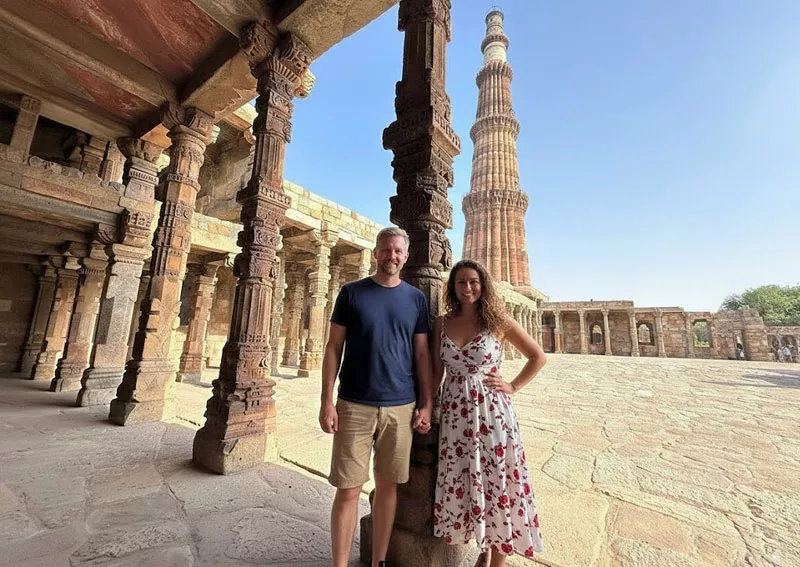
Qutub Minar rises about 73 metres over South Delhi and is widely recognised as the tallest brick minaret in India. The complex dates to the late 12th and early 13th centuries, when Qutb‑ud‑Din Aibak and his successors began consolidating the Delhi Sultanate. The minaret’s fluted red sandstone shafts carry bands of Quranic calligraphy, while the surrounding Quwwat‑ul‑Islam Mosque famously reuses carved pillars from earlier Hindu and Jain temples, visually capturing the transition from temple to mosque architecture.
You also find the rust‑resistant Iron Pillar here, a much older artefact that showcases advanced metallurgy and has stood for over a millennium without significant corrosion. Neatly maintained lawns, clear pathways, and interpretive boards make the site approachable even for first‑time visitors to India.
Visiting tips
- Best time: Early morning or late afternoon for softer light and smaller crowds.
- Time needed: Around 1.5–2 hours, including a slow walk through the mosque, minar views, and secondary monuments.
- Combine with: Mehrauli Archaeological Park or a relaxed café stop in South Delhi to ease jet lag on your first day.
Humayun’s Tomb, Delhi
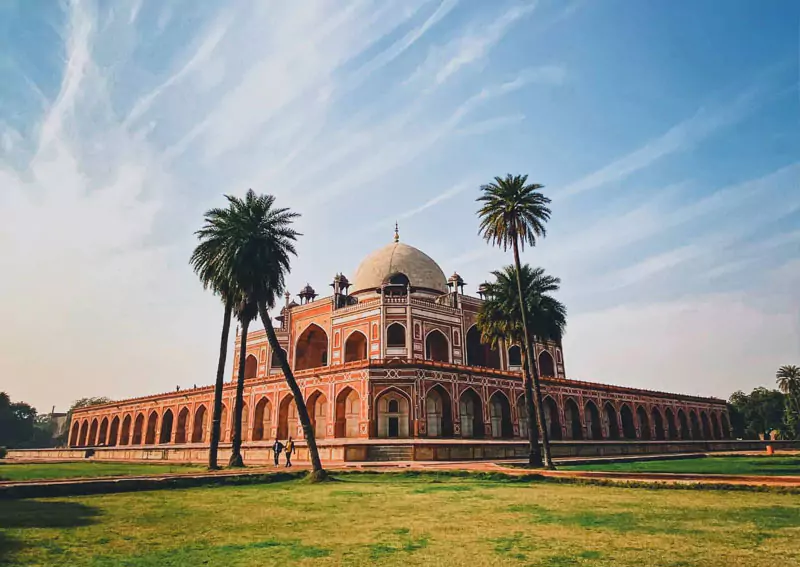
Humayun’s Tomb, completed in the 16th century, marks a turning point in Mughal funerary architecture and is widely seen as a direct precursor to the Taj Mahal. The complex uses a symmetrical charbagh garden divided into four main quadrants by water channels, a layout inspired by Persian concepts of a garden paradise. The tomb itself blends red sandstone and white marble, layering Persian design with Indian features like chhatris and ornamental arches.
Conservation work by the Aga Khan Trust and Archaeological Survey of India has restored intricate details, revived water channels, and stabilised the surrounding tombs. This attention to authenticity gives you a strong sense of how early Mughal landscapes were meant to look and feel.
Visiting tips
- Best time: Late afternoon for golden light on the dome and quieter paths.
- Time needed: 1.5–2 hours, allowing time to explore subsidiary tombs and the garden.
- Combine with: Nearby Isa Khan’s Tomb and Nizamuddin area for a more complete historic neighbourhood experience.
Red Fort Complex, Delhi
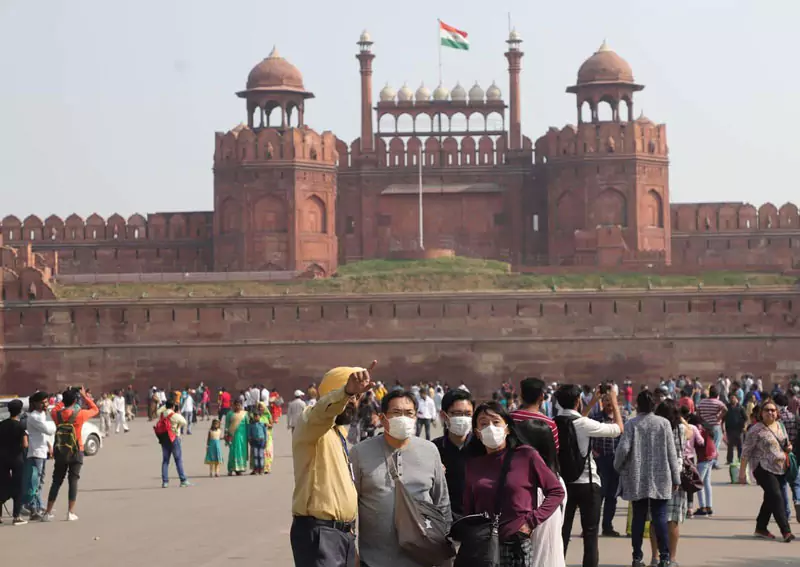
The Red Fort in Old Delhi, built under Shah Jahan in the 17th century, served as the main Mughal palace complex and a symbolic seat of power. Extensive walls and imposing gateways protect an interior filled with audience halls, royal apartments, and gardens. The Diwan‑i‑Am (Hall of Public Audience) and Diwan‑i‑Khas (Hall of Private Audience) illustrate how the emperor interacted with both the public and selected nobility.
In modern India, the Red Fort carries strong national significance because the Prime Minister hoists the national flag from its ramparts each Independence Day. Sound‑and‑light shows bring the story of the fort and the city to life at night, creating an atmospheric experience against the backdrop of lit sandstone and marble.
Visiting tips
- Best time: Mornings for lower day‑time crowds or evenings for the sound‑and‑light show.
- Time needed: 2–3 hours, including museum galleries if open.
- Combine with: Jama Masjid and Chandni Chowk for a full Old Delhi heritage circuit.
Agra’s Power Trio: Taj, Fort, and the “Ghost City” of Fatehpur Sikri
Agra and its surroundings hold three major UNESCO World Heritage Sites that capture the rise, peak, and experimentation of Mughal power. Because the distances between these landmarks are short, travelers can explore all three comfortably over 1.5–2 days with smart planning around sunrise and sunset. Including these historic sites in your Agra Tour allows you to experience the architectural brilliance and imperial legacy that make the city one of India’s most fascinating cultural destinations.
Taj Mahal, Agra

The Taj Mahal needs no introduction, but understanding it in context deepens your visit. Built in the mid‑17th century by Shah Jahan as a mausoleum for Mumtaz Mahal, it combines a perfectly symmetrical plan, an iconic onion dome, intricate pietra dura inlay work, and carefully managed water features. The use of white Makrana marble and precious stones was unprecedented at its scale, turning the entire complex into a luminous sculpture that changes colour with the light.
The Taj belongs to the category of cultural UNESCO sites for its global architectural significance and refined craftsmanship. Conservation remains ongoing due to air pollution and visitor pressure, with measures such as controlled entry, traffic restrictions, and occasional clay‑pack treatments to manage discolouration.
Visiting tips
- Best time: Sunrise for softer light, cooler temperatures, and lower crowd density.
- Tickets: Separate pricing for foreign and domestic visitors, with optional add‑ons for main mausoleum access.
- Photo tip: Visit Mehtab Bagh across the river for symmetrical, less crowded views of the Taj, especially at sunset.
Agra Fort, Agra
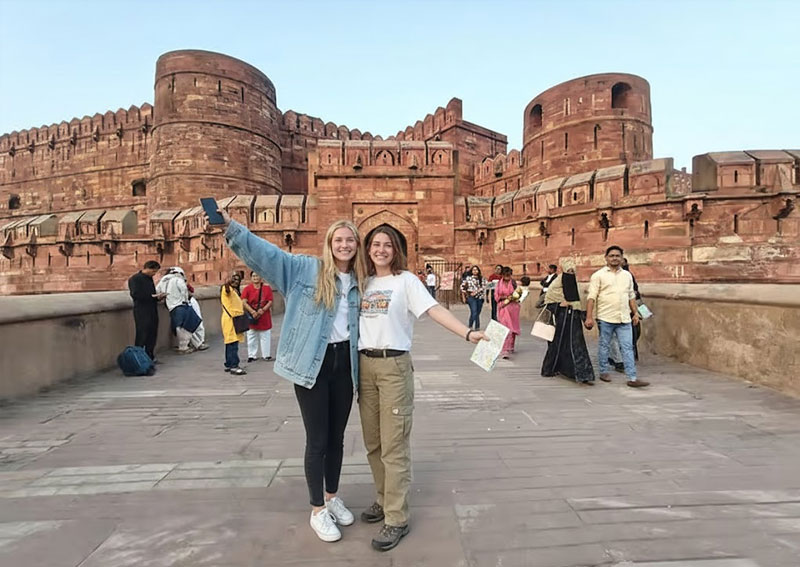
Agra Fort, also a UNESCO World Heritage Site, predates the Taj and served as the main Mughal stronghold before the capital shifted again. Massive red sandstone walls enclose a complex of palaces, halls, and courtyards used by Akbar, Jahangir, and Shah Jahan. Later marble additions and river‑facing pavilions show how the fort evolved from a strictly military installation into a royal residence.
From certain balconies, you can see the Taj Mahal in the distance, creating a poignant visual link between power and memory. Many travellers find that touring Agra Fort first gives them a more complete sense of Mughal life before stepping into the more romanticised world of the Taj.
Visiting tips
- Best time: Late morning or mid‑afternoon, ideally paired with a Taj visit the same day.
- Time needed: 1.5–2 hours for main palaces, audience halls, and viewpoints.
- Mobility: The complex involves some uphill walking; wear comfortable footwear.
Fatehpur Sikri, near Agra
Fatehpur Sikri, approximately an hour’s drive from Agra, is a planned Mughal capital that briefly flourished under Akbar before water shortages and political shifts led to its abandonment. Today it survives as a remarkably intact “ghost city,” complete with palaces, courtyards, religious structures, and gateways such as the monumental Buland Darwaza.
The complex showcases a unique mix of architectural influences, reflecting Akbar’s interest in different faiths and traditions. Intricately carved pillars, private audience halls, and the white marble tomb of Salim Chishti all point to a court that experimented with ideas as much as with stone.
Visiting tips
- Best time: Morning or late afternoon, especially if you are travelling between Agra and Jaipur.
- Time needed: Around 2 hours inside the core complex and religious courtyard.
- Logistics: Many Golden Triangle itineraries include Fatehpur Sikri as a stop on the road from Agra to Jaipur, breaking up the journey.
Jaipur’s UNESCO Sites: Science, Urban Planning, and the Living Pink City
Jaipur, capital of Rajasthan, closes the loop with a blend of Rajput fortification, city planning, and astronomical science. Two key UNESCO listings here—Jantar Mantar and the historic walled city—offer a different flavour from the Mughal‑heavy sites in Delhi and Agra.
Jantar Mantar, Jaipur
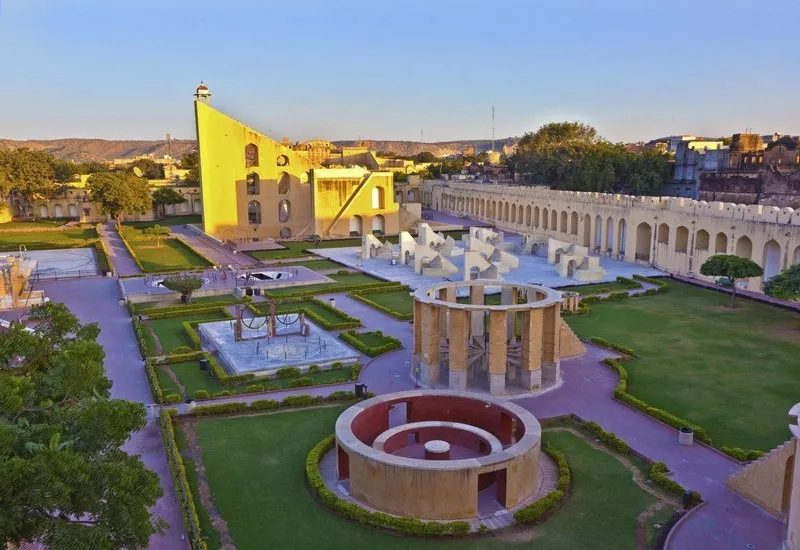
Jantar Mantar is a collection of giant masonry instruments that measure time, celestial positions, and planetary movements with impressive precision. Built in the early 18th century under Maharaja Sawai Jai Singh II, the observatory stands out because the instruments remain accurate and use purely structural elements rather than telescopes or complex machinery.
The most famous structure, the Samrat Yantra, functions as a massive sundial capable of tracking time to within seconds when skilfully read. Other instruments calculate declination, azimuth, and positions of key stars. For visitors, Jantar Mantar offers a tangible, walk‑through experience of pre‑modern scientific practice.
Visiting tips
- Best time: Late morning or mid‑afternoon when shadows are clear and guides can demonstrate readings.
- Time needed: About 1–1.5 hours with a local guide to interpret each instrument.
- Combine with: City Palace and Hawa Mahal, as all three lie within walking distance inside the old city.
Jaipur Historic Walled City (Pink City)
Jaipur’s historic centre, inscribed as a UNESCO World Heritage site in recent years, represents one of India’s earliest and best-preserved examples of planned urban design. The city follows a grid layout inspired by traditional Indian architectural texts, with wide avenues, defined bazaars, and distinct zones for administration, trade, and residence.
The “Pink City” nickname comes from the warm terracotta hue applied to facades, a tradition that began as a royal gesture to welcome a British prince in the 19th century and was later preserved as a symbol of civic identity. Within the historic walled city, visitors can explore landmarks such as the Hawa Mahal, vibrant markets like Johari Bazaar and Bapu Bazaar, and gate-lined streets that continue to serve as bustling commercial hubs—highlights that are often included in a memorable Jaipur Sightseeing Tour.
Visiting tips
- Best way to explore: On foot, by cycle‑rickshaw, or with a guided heritage walk that connects bazaars, temples, and viewpoints.
- Time needed: Half a day to a full day, including shopping and café stops.
- Photography: Sunrise and early morning bring soft light, less traffic, and vibrant market scenes as shutters open.
Optional UNESCO Add‑On: Keoladeo National Park (Bharatpur)
If you want to add a natural UNESCO site to your cultural loop, consider Keoladeo National Park near Bharatpur, roughly midway between Agra and Jaipur. The park is a man‑made wetland famous for migratory and resident bird species, making it a favourite among birders and photographers.
Cycle‑rickshaws and walking paths bring you close to herons, storks, kingfishers, and, in good years, rarer winter visitors. The site demonstrates how managed wetlands can support biodiversity and local livelihoods while remaining accessible to visitors.
Visiting tips
- Best time: November to February for peak bird activity and comfortable temperatures.
- Time needed: Half a day; many travellers stop here for a morning or afternoon ride on the way between Agra and Jaipur.
- Gear: Binoculars and a telephoto lens significantly improve the experience, and rickshaw guides often help with spotting and identification.
Practical Itinerary: 5–7 Days of UNESCO Highlights
You can cover the eight main UNESCO sites (plus Bharatpur if you wish) over five to seven days with efficient routing and a mix of early starts and relaxed evenings. Private car with driver usually gives you the best balance of comfort and flexibility, though trains and local transport can work if you prefer a more independent style.
Sample 5‑Day UNESCO‑Focused Plan
- Day 1 – Delhi arrival and South Delhi monuments
Morning/afternoon: Qutub Minar complex, Humayun’s Tomb.
Evening: Relaxed dinner, optional drive past India Gate and central Delhi. - Day 2 – Old Delhi and Red Fort, then Agra
Morning: Red Fort and Jama Masjid or Chandni Chowk.
Afternoon: Drive or train to Agra (around 3–4 hours).
Evening: Mehtab Bagh views of the Taj at sunset. - Day 3 – Taj Mahal and Agra Fort
Sunrise: Taj Mahal main visit.
Late morning: Agra Fort.
Afternoon: Free time, craft demonstrations, or local markets. - Day 4 – Fatehpur Sikri and (optionally) Keoladeo, then Jaipur
Morning: Drive toward Jaipur, stopping at Fatehpur Sikri for a guided tour.
Midday or afternoon: Optional detour into Keoladeo National Park by cycle‑rickshaw.
Evening: Arrive in Jaipur, short orientation walk or dinner in the Pink City. - Day 5 – Jaipur UNESCO core
Morning: Jantar Mantar and City Palace.
Midday/afternoon: Heritage walk through the walled city and bazaars, Hawa Mahal photo stop.
Evening: Optional extension day for Amber Fort (non‑UNESCO but closely linked) or return to Delhi.
With a sixth or seventh day, you can comfortably add Amber Fort, more museum time, or a slower pace that includes café breaks and shopping without ever feeling rushed.
Costs, Tickets, and Practical Logistics
Entry fees, guide charges, and local transport form the core of your UNESCO budget. Foreign travellers can expect monument entry totals of roughly ₹3,500–7,000 across the main Golden Triangle highlights, depending on how many secondary sites they add. Domestic travellers pay significantly lower per‑site fees.
Typical 2026 Cost Ranges
- Monument entries (foreign visitors, major sites only): roughly ₹5,500–7,000 across Delhi, Agra, Jaipur.
- Private car with driver (5–7 days loop): commonly quoted ₹20,000–25,000+ depending on vehicle type and inclusions.
- Local guides at major monuments: around ₹800–1,200 per site for licensed guiding, often bookable at official counters.
Using a knowledgeable driver or a trusted tour operator simplifies timekeeping, parking, and ticket windows and allows you to group sites sensibly by location and time of day.
How to Make the Most of Each UNESCO Visit
A few smart habits help you experience these sites deeply instead of just ticking them off a list:
- Visit early or late in the day to avoid harsh light and peak crowds.
- Use licensed local guides or high‑quality audio guides for context, especially at complex sites like Fatehpur Sikri and Jantar Mantar.
- Carry water, sun protection, and modest, breathable clothing suitable for religious and royal environments.
- Allow buffer time for queues and security checks at flagship monuments such as the Taj Mahal and Red Fort.
These simple steps keep the trip comfortable and give you space to enjoy details—carvings, inscriptions, acoustics, and views—that rushed visitors often miss.
Plan Your UNESCO‑Rich Golden Triangle Now
The Golden Triangle gives you a rare chance to walk through eight UNESCO World Heritage Sites in a single, coherent journey. You see how early sultanate towers evolve into Mughal garden tombs, how imperial forts give way to planned capitals, and how Rajput rulers respond with precise observatories and disciplined city grids. With solid infrastructure, clear pricing, and multiple transport options, you can build a heritage‑heavy itinerary that still feels relaxed and rewarding.
If you share your travel month, trip length, and comfort level (private car, train, or mixed), I can map out a fully customised, step‑by‑step UNESCO Golden Triangle plan—including best time slots for each site, suggested hotels near the monuments, and women‑friendly safety tips tailored to your style of travel.