
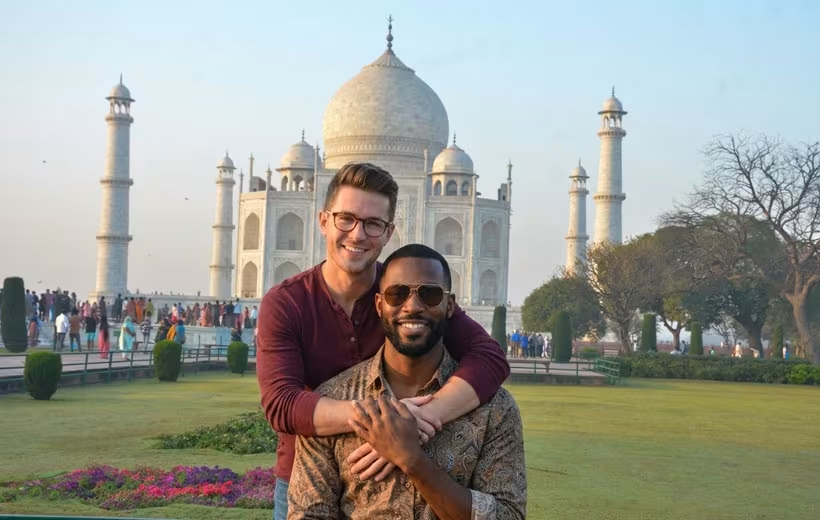
Best LGBTQ-Friendly Cities in India: Safe Travel Guide for 2026
India can be a rewarding destination for LGBTQ+ travellers, but the experience can vary from one city, neighbourhood and hotel to another. For most international visitors, Mumbai, Delhi, Bengaluru and Goa offer the strongest mix of cosmopolitan culture, established tourism services, quality accommodation and everyday privacy.
Jaipur and Agra are also practical choices for couples who want heritage sightseeing, especially when the trip is organised around reputable hotels, private transport and experienced local guides. Kochi and Puducherry suit travellers who prefer a quieter pace, boutique accommodation, coastal experiences and less hectic city travel.
This guide focuses on what LGBTQ+ travel in India actually feels like: current legal context, city-by-city differences, hotels, public etiquette, same-sex couple travel, transgender travel, solo safety, dating-app precautions and how to plan a comfortable LGBTQ-friendly Golden Triangle itinerary through Delhi, Agra and Jaipur.

Quick Answer
Which Indian Cities Are Most LGBTQ-Friendly for Travellers?
Mumbai, Delhi, Bengaluru and Goa are among the easiest Indian destinations for many LGBTQ+ travellers. They offer a useful combination of international hotels, cosmopolitan neighbourhoods, modern restaurants, established tourism services and greater personal privacy. Jaipur and Agra work particularly well for cultural trips with private transport, while Kochi and Puducherry are better for travellers who prefer a slower holiday.
Best for visible urban life
Mumbai, Delhi & Bengaluru
Cosmopolitan City Life
Large cities with international hotels, restaurants and diverse neighbourhoods.
Independent or Private
Good choice for first-time visitors who want flexibility.
Good For
- First-time LGBTQ+ visitors
- Food and nightlife
- Arts and cultural events
- Longer city stays
- Independent travellers
Best for relaxed couples
Goa, Kochi & Puducherry
Slower Private Travel
Beach, heritage, boutique hotels and wellness experiences.
Couples & Leisure
Good for travellers who want privacy and fewer rushed sightseeing days.
Good For
- Same-sex couples
- Beach holidays
- Boutique stays
- Wellness travel
- Slower itineraries
Know the Law
What Should LGBTQ+ Travellers Know About Indian Law?
Consensual same-sex relationships between adults in private are not criminal in India. However, this does not mean that every aspect of LGBTQ+ life has the same legal recognition as it does in some other countries.
In 2018, the Supreme Court read down Section 377 so it no longer criminalises consensual sexual conduct between adults in private. The decision was an important constitutional change for LGBTQ+ people in India.
Same-sex marriage is not currently legally recognised in India. In 2023, the Supreme Court did not create a legal right to same-sex marriage and left changes to the marriage framework to the legislature.
The Transgender Persons (Protection of Rights) Act, 2019 prohibits specified forms of discrimination against transgender people in areas such as education, employment, healthcare and access to public places.
| Issue | Current Position | What It Means for Travellers |
|---|---|---|
| Consensual same-sex relationships | Not criminal between adults in private | Same-sex couples are not illegal simply for travelling together |
| Same-sex marriage | Not legally recognised | Foreign marriage status may not receive identical local legal treatment |
| Transgender protections | National legislation exists | Legal protections exist, although practical experiences can vary |
| Social acceptance | Varies by location and setting | Hotel, neighbourhood and travel style remain important |
This Is Travel Guidance, Not Legal Advice
Laws and court interpretations can change. Travellers dealing with marriage, immigration, documentation or medical issues should verify current official information or obtain qualified legal advice.
Everyday Travel
How LGBTQ-Friendly Is India in Practice?
LGBTQ+ travellers can often travel comfortably in major Indian cities and established tourist destinations, but everyday attitudes vary considerably. International hotels, major monuments, modern restaurants and private tours generally provide more predictable experiences than small unreviewed accommodation or unfamiliar rural settings.
In many places, two same-sex adults travelling together may simply be assumed to be friends, relatives or colleagues. You may occasionally encounter personal questions or staring, especially outside major metropolitan areas.
Public affection in India is often restrained for heterosexual couples as well. Holding hands or sitting close may attract little attention in one neighbourhood while kissing publicly in a conservative market, religious location or smaller town may draw unwanted attention.
Usually More Comfortable
International hotels, reputable boutique properties, cosmopolitan neighbourhoods, private tours, established tourist centres, restaurants and major beach resorts.
Use More Discretion
Religious sites, rural areas, isolated nightlife locations, remote towns, poorly reviewed accommodation and unfamiliar areas late at night.
Choose the Right Destination
Best LGBTQ-Friendly Cities in India at a Glance
Mumbai, Delhi, Bengaluru and Goa are strong choices for first-time LGBTQ+ travellers, while Jaipur, Agra, Kochi and Puducherry suit more specific travel styles. The comparison below is an editorial travel guide rather than an official safety ranking.
| Destination | Best For | Travel Feel | Public Discretion |
|---|---|---|---|
| Mumbai | Community, food, arts and nightlife | Cosmopolitan and fast-paced | Moderate |
| Delhi | History and Golden Triangle access | Diverse and intense | Moderate |
| Goa | Beaches and couples | International and informal | Lower in established tourist areas |
| Bengaluru | Modern city life | Young and cosmopolitan | Moderate |
| Jaipur | Heritage and luxury | Traditional and tourism-focused | Higher in public areas |
| Agra | Taj Mahal and cultural sightseeing | Short-stay heritage destination | Higher outside tourist hotels |
| Kochi & Kerala | Nature and wellness | Quiet and slower | Moderate to higher rurally |
| Puducherry | Boutique heritage travel | Relaxed and compact | Moderate |
City 1
Is Mumbai LGBTQ-Friendly for Travellers?
Mumbai is one of the strongest all-round choices for LGBTQ+ visitors who want a large cosmopolitan Indian city. It combines diverse neighbourhoods, international hotels, restaurants, arts, entertainment and a visible queer cultural history.
The size of Mumbai also creates useful anonymity. You are one traveller among millions of residents, business visitors and tourists moving through the city each day.
Where Should First-Time Visitors Stay?
Colaba and South Mumbai are useful for heritage sightseeing. Bandra works well for restaurants, cafés and a more residential atmosphere. Major business districts provide reliable international hotel options.
Why Mumbai Works Well
- Large and diverse population
- Strong hotel choice
- Established arts and entertainment scene
- Visible queer cultural community
- International restaurants and nightlife
- Good domestic and international flights
What to See
Gateway of India, Marine Drive, Kala Ghoda, Chhatrapati Shivaji Maharaj Terminus, Elephanta Caves and Mumbai’s neighbourhood food scene.
Stay Close to Your Plans
Mumbai is enormous. Choosing the right neighbourhood can save more time and stress than choosing the most luxurious hotel across the city.
City 2
Is Delhi LGBTQ-Friendly for International Travellers?
Delhi can work very well for LGBTQ+ travellers because it offers international hospitality, diverse neighbourhoods and excellent access to the Golden Triangle. The important thing to understand is that Delhi is not one uniform social environment.
Old Delhi, Connaught Place, Aerocity, Hauz Khas and South Delhi can feel completely different from each other. Choosing the right hotel area therefore matters.
Best Areas for Visitors
- Aerocity for airport convenience
- Connaught Place for central sightseeing access
- South Delhi for restaurants and residential comfort
- Established luxury and heritage properties across central Delhi
What to See
Humayun’s Tomb, Qutub Minar, India Gate, Gurudwara Bangla Sahib, Old Delhi and the Red Fort area.
Why Delhi Is Useful for LGBTQ+ Couples
Delhi has one of India’s broadest selections of professional hotels and private travel services. It is also the most convenient starting point for Delhi–Agra–Jaipur travel.
Explore our LGBTQ Golden Triangle Luxury Tour.
Destination 3
Is Goa LGBTQ-Friendly for Couples?
Goa is one of India’s most relaxed holiday destinations for many LGBTQ+ couples. Its long-established domestic and international tourism culture creates a different atmosphere from inland heritage cities.
The experience changes significantly between North and South Goa, so choose according to the kind of holiday you want.
North Goa or South Goa?
North Goa
Best for: restaurants, nightlife, cafés and social travel.
Choose North Goa when you want a more active holiday and a wider selection of casual places to eat and go out.
South Goa
Best for: couples, resorts, privacy and quieter beaches.
South Goa generally suits travellers who want a slower schedule and spend more time at their accommodation.
Normal beach and nightlife precautions still apply. Use verified transport after late evenings, avoid isolated beaches at night and keep control of your own drinks.
City 4
Is Bengaluru LGBTQ-Friendly?
Bengaluru is one of India’s most cosmopolitan modern cities and can be a comfortable destination for LGBTQ+ travellers interested in contemporary urban life.
The city’s technology sector, universities, creative industries and younger professional population contribute to a social environment that can feel noticeably different from many smaller Indian cities.
Why Add Bengaluru?
- Young professional population
- Good restaurant and café culture
- Modern hotels
- Arts and social events
- Strong domestic flight connections
- Useful gateway to Karnataka
The main practical challenge is traffic. Choose accommodation close to the neighbourhoods, restaurants and activities you actually plan to use.
City 5
Is Jaipur LGBTQ-Friendly for Couples?

Jaipur is a good LGBTQ+ travel destination when your priority is heritage, private sightseeing and high-quality hospitality rather than queer nightlife.
The city has an established luxury and heritage hotel industry serving travellers from around the world. For couples, a reputable hotel plus a private driver can remove much of the uncertainty from sightseeing.
Best Jaipur Experiences
- Amber Fort early in the morning
- City Palace
- Jantar Mantar
- Hawa Mahal viewpoint
- Private textile or block-printing experience
- Heritage hotel dinner
- Old-city market walk
Public Etiquette in Jaipur
Jaipur remains more traditional than Mumbai or Bengaluru. Keep public affection modest in markets, religious places and busy traditional neighbourhoods. This is sensible advice for couples generally.
City 6
Is Agra LGBTQ-Friendly for Taj Mahal Visitors?
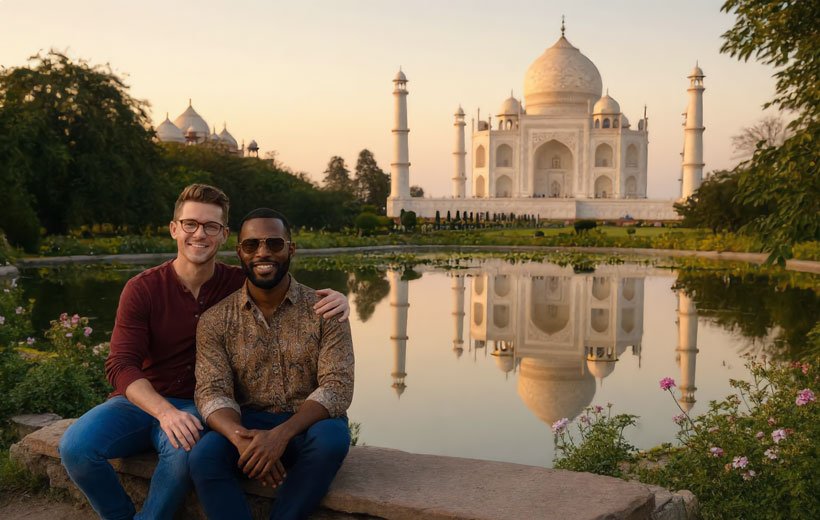
Agra is straightforward for many LGBTQ+ travellers when it is treated as a cultural destination rather than a social or nightlife destination. Most international visitors come primarily for the Taj Mahal and Agra Fort.
A reputable hotel, confirmed room reservation and pre-arranged transport make the short stay much easier.
Best Approach for Agra
- Stay in an established tourist hotel
- Confirm one double room before arrival
- Use official Taj Mahal ticket channels
- Use an authorised or reputable guide
- Arrange transport in advance
- Politely decline unwanted shopping stops
Read our guide to visiting the Taj Mahal in one day.
Destination 7
Is Kochi and Kerala Good for LGBTQ+ Travellers?
Kerala works well for travellers who value privacy, nature, wellness and slower itineraries. Kochi provides the easiest urban introduction through heritage neighbourhoods, art spaces, restaurants and established tourism infrastructure.
Rural Kerala can feel more socially conservative than Kochi, but private resorts, quality hotels and established houseboats can provide comfortable environments for couples.
Good Kerala Experiences
- Fort Kochi
- Private backwater cruise
- Munnar tea-country stay
- Wellness resort
- Ayurveda retreat
- Periyar wildlife area
Destination 8
Is Puducherry LGBTQ-Friendly?
Puducherry can be a good choice for LGBTQ+ travellers who want a compact, quieter and more boutique-style India experience.
White Town offers heritage architecture, cafés, coastal walks and boutique hotels. The destination can be combined with Chennai or included in a longer Tamil Nadu itinerary.
Auroville has its own community character and visitor arrangements, so research accommodation and access separately rather than treating it as part of central Puducherry.
The Most Important Booking
How Do You Choose an LGBTQ-Friendly Hotel in India?
Look for professional service rather than relying only on an “LGBTQ-friendly” marketing label. Established hotels with strong international reviews and clear room policies are generally easier for same-sex couples and LGBTQ+ travellers.
Questions Worth Asking Before Booking
- Can two adults of the same gender share one double room?
- Which identification documents are required?
- Is the booked bed type guaranteed?
- Does the hotel offer airport pickup?
- Is reception staffed at night?
- Can the hotel arrange reliable private transport?
- Are recent international guest reviews available?
Keep the Question Simple
You do not need to explain your relationship. Ask whether two adult guests can share the selected double room and request written confirmation.
International Brand or Independent Hotel?
International hotel brands can offer more standardised procedures, but many independent and heritage hotels provide excellent personalised service. Recent reviews and clear communication are more important than the brand name alone.
Travelling Together
Can Same-Sex Couples Travel Comfortably in India?
Yes, many same-sex couples travel through India’s major tourist destinations comfortably. Choosing established hotels, clearly booking one double room and using reliable transport removes many practical uncertainties.
- Book one double room clearly
- Keep the hotel confirmation available
- Stay in established tourist areas
- Choose central neighbourhoods for evening dining
- Use private or verified transport after late dinners
- Keep public affection modest in conservative settings
- Raise genuinely poor treatment with hotel management
If a hotel refuses a confirmed room arrangement, speak to management or the booking platform and consider moving to a more professional property when practical.
Transgender Travel
What Should Transgender Travellers Know Before Visiting India?
Transgender and gender-diverse travellers should make sure transport reservations and identification details are consistent wherever official documents are required.
Questions can arise when a traveller’s name, photograph or gender marker differs across documents, so keeping records organised can make airport, hotel and rail check-ins easier.
- Use the legal name shown on travel documents
- Keep flight and train bookings consistent
- Carry passport and visa copies
- Keep medication in labelled packaging
- Carry prescriptions where relevant
- Allow extra time for airport security
- Contact hotels in advance when documentation may cause confusion
- Save operator and embassy contact information
India’s Transgender Persons Act includes anti-discrimination provisions, although real-world experiences can still vary according to staff awareness and local practice.
Travelling Independently
Is Solo LGBTQ+ Travel in India Possible?
Yes, but solo travellers should use the same practical precautions they would use in other large unfamiliar cities. The main difference is that you do not have an immediate companion if a hotel, transport arrangement or social interaction becomes uncomfortable.
- Arrive in unfamiliar cities during daylight when possible
- Use reputable hotels
- Share transport details with someone you trust
- Use verified app-based or pre-arranged transport
- Meet new people first in public places
- Do not reveal your room number unnecessarily
- Keep control of your own drink
- Trust your instincts when a situation feels wrong
Read the Setting
What Should LGBTQ+ Couples Know About Public Affection in India?
Public affection in India is generally more restrained than in many Western destinations, regardless of sexual orientation. Reading the setting is more useful than following one rule for the entire country.
Holding hands may attract little attention in one area but more attention in another. Kissing in crowded public places may draw stares for heterosexual and same-sex couples alike.
Usually More Relaxed
International hotels, private resorts, tourist beaches, modern restaurants and cosmopolitan social spaces.
Keep It More Reserved
Religious places, traditional markets, railway stations, rural areas and conservative family environments.
At temples, mosques, gurdwaras and other religious sites, respect clothing requirements, remove shoes where requested and follow local photography rules.
Phones and Social Apps
Are Dating Apps Safe for LGBTQ+ Travellers in India?
Dating and social apps can be used, but travellers should protect their identity, live location, hotel information and financial details.
- Do not publish your hotel room number
- Meet new contacts in public places first
- Use your own verified transport
- Tell someone where you are going
- Do not send passport copies
- Never share banking information
- Be cautious when someone quickly asks for money
- Consider a separate travel profile when privacy matters
End Contact if Someone Threatens or Pressures You
Requests for money, blackmail threats, demands for private documents or pressure to move somewhere isolated are reasons to end contact immediately.
Delhi, Agra and Jaipur
How Do You Plan an LGBTQ-Friendly Golden Triangle Tour?
The Delhi–Agra–Jaipur Golden Triangle is one of the easiest cultural routes in India for LGBTQ+ travellers because all three cities have established hotels, private transport and experienced tourism services.
Days 1–3
Delhi
Stay in Aerocity, Connaught Place or a suitable South Delhi hotel. Explore Old Delhi, Humayun’s Tomb, Qutub Minar and central New Delhi while keeping one evening for a good restaurant or relaxed neighbourhood experience.
Day 4
Agra
Travel by private car, visit Agra Fort and stay in a reputable hotel near the Taj Mahal. Confirm the room and early-morning transport before arrival.
Days 5–7
Jaipur
Choose a quality heritage, boutique or international hotel and explore Amber Fort, City Palace, Jantar Mantar and Jaipur’s old markets with private transport.
Why Does Private Transport Help?
- No repeated fare negotiation
- Known driver between cities
- Secure luggage during transfers
- Flexible hotel and restaurant stops
- Less dependence on unfamiliar transport late at night
- Easier airport and railway-station transfers
Explore our LGBTQ Golden Triangle Luxury Tour or compare all Golden Triangle Tour Packages.
When to Travel
What Is the Best Time for an LGBTQ+ India Trip?
October to March is generally the most comfortable period for Delhi, Agra and Jaipur. Cooler weather makes sightseeing easier, although this is also one of the busiest tourism periods.
Delhi, Agra and Jaipur
October through March usually provides the best conditions for monuments, markets and long outdoor sightseeing days.
Goa
The cooler months are also popular for Goa because beach, restaurant and nightlife conditions are generally more comfortable.
Kerala
Kerala can work across several seasons, although monsoon changes road, beach and backwater conditions.
Pride Events
Event dates can change from year to year. Check current organiser announcements before booking flights specifically around a Pride march or festival.
Avoid These Errors
What Are the Biggest LGBTQ+ Travel Mistakes in India?
- Assuming one city represents all of India. Attitudes vary significantly by region and neighbourhood.
- Booking the cheapest unreviewed hotel. Staff professionalism is worth paying for.
- Leaving the room type unclear. Confirm one double room for two adults.
- Depending on random late-night transport. Use verified or pre-arranged transport.
- Sharing hotel information too quickly. Protect your room number and live location.
- Expecting the same public-affection norms everywhere. Read the environment.
- Believing every LGBTQ-friendly marketing label automatically. Check actual reviews.
- Using old Pride dates. Confirm the current year’s announcement.
- Confusing legal status with identical social acceptance everywhere.
- Ignoring poor treatment. Contact hotel management or move when necessary.
Before You Book
LGBTQ+ India Travel Checklist
- Check current India entry requirements
- Check current regional travel advice
- Book accommodation with recent reviews
- Confirm one double room for two adults
- Keep written booking confirmation
- Arrange the first airport transfer
- Use the legal name shown on travel documents
- Keep passport and visa copies securely
- Save hotel and tour-operator contacts
- Use verified intercity transport
- Research neighbourhoods, not only city names
- Keep public affection appropriate to the setting
- Meet new contacts in public places first
- Protect hotel and live-location information
- Carry medication in original packaging
- Check official Pride dates before booking around events
- Choose suitable travel insurance
Choose by Travel Style
Which LGBTQ-Friendly Indian Destination Is Best for You?
Best Overall: Mumbai
Choose Mumbai for cosmopolitan city life, restaurants, arts, international hospitality and visible queer culture.
Best First India Trip: Delhi
Choose Delhi for major heritage sights plus easy access to Agra and Jaipur.
Best Relaxed Couple Trip: Goa
Choose Goa for beaches, resorts, privacy and a slower holiday atmosphere.
Best Heritage Couple Trip: Jaipur
Choose Jaipur for palace hotels, Rajasthan heritage and private sightseeing.
Best Modern City: Bengaluru
Choose Bengaluru for cafés, restaurants, nightlife and contemporary urban culture.
Best Quiet Escape: Kochi or Puducherry
Choose Kochi or Puducherry for boutique accommodation, heritage and a slower itinerary.
Related India Travel Guides
Plan a Comfortable India Itinerary
Want a Private, Respectful India Trip?
Plan an LGBTQ-Friendly Golden Triangle Itinerary
Tell us your travel dates, preferred hotel style, number of travellers and pace. We can organise private transport, suitable accommodation and experienced local guides for Delhi, Agra and Jaipur without forcing you into a fixed group itinerary.
- Private airport transfers
- Private Delhi–Agra–Jaipur transport
- Carefully selected hotels
- Flexible sightseeing schedule
- Experienced local guides
- Clear communication before arrival
Common Questions
Frequently Asked Questions About LGBTQ+ Travel in India
Direct answers to common questions about LGBTQ-friendly cities, hotels, couples, safety and Golden Triangle travel in India.
Is India safe for LGBTQ+ travellers?
Many LGBTQ+ travellers visit India’s major cities and tourist routes comfortably. Choose reputable accommodation, use verified transport and adjust public behaviour to the local setting.
Are same-sex relationships legal in India?
Consensual same-sex sexual conduct between adults in private is not criminal following the Supreme Court’s 2018 Navtej Singh Johar judgment.
Is same-sex marriage legal in India?
No. Same-sex marriage is not currently legally recognised in India.
Which Indian city is most LGBTQ-friendly?
Mumbai is one of the strongest all-round choices because it combines a diverse population, international hospitality, arts, restaurants and visible queer culture. Delhi, Bengaluru and Goa are also strong choices.
Can a same-sex couple share a hotel room in India?
Established hotels on major tourist routes generally accept two adult guests sharing a room. Confirm one double room and identification requirements before arrival.
Is the Golden Triangle suitable for LGBTQ+ couples?
Yes. Delhi, Agra and Jaipur have extensive tourism infrastructure and work especially well when couples use reputable hotels and private transport.
Is Goa LGBTQ-friendly?
Goa is one of India’s most relaxed destinations for many LGBTQ+ travellers, particularly in established beach, resort and tourism areas.
Is Delhi LGBTQ-friendly?
Delhi can be comfortable for LGBTQ+ travellers when you choose established hotels and well-connected neighbourhoods. It also provides easy access to Agra and Jaipur.
Is Jaipur LGBTQ-friendly?
Jaipur works particularly well for heritage-focused LGBTQ+ travellers using reputable hotels, private sightseeing and culturally aware public behaviour.
Is Agra comfortable for LGBTQ+ couples?
Yes. Agra is usually straightforward when accommodation, Taj Mahal sightseeing and transport are booked with professional tourism providers.
Should LGBTQ+ couples avoid public affection in India?
Public affection is generally more restrained in India for couples of all orientations. Greater discretion is sensible in religious sites, traditional markets and conservative settings.
What should transgender travellers prepare before visiting India?
Use the exact legal name shown on travel documents, keep transport reservations consistent, carry relevant medication records and allow extra time where identity checks are required.
Are dating apps safe for LGBTQ+ travellers in India?
Use normal digital-safety precautions. Meet people in public places first, protect your hotel information and never respond to demands for money or threats involving private messages.
Do I need an LGBTQ-specific tour operator?
No, but a respectful private operator can make hotel selection, airport transfers and intercity transport easier, particularly for a first India trip.
What is the best time for an LGBTQ+ Golden Triangle trip?
October to March is generally the most comfortable broad period for Delhi, Agra and Jaipur because daytime sightseeing conditions are easier than during the hottest months.
Final Advice
Which LGBTQ-Friendly Destination in India Should You Choose?
For most first-time LGBTQ+ visitors, Mumbai, Delhi, Bengaluru and Goa are the easiest places to begin. Mumbai offers cosmopolitan city life, Delhi combines history with Golden Triangle access, Bengaluru provides a modern urban experience and Goa works particularly well for relaxed couples.
Jaipur and Agra are excellent cultural additions when you use professional hotels and private transport. Kochi and Puducherry work better for travellers seeking boutique accommodation and a slower itinerary.
No Indian city can be labelled universally safe or welcoming in every neighbourhood and every situation. The most comfortable trip comes from combining the right destination with a reputable hotel, reliable transport, realistic cultural awareness and enough flexibility to make your own choices.