

Delhi, Agra, and Jaipur form India’s famous Golden Triangle, a 720‑kilometre circuit that links Mughal tombs, Rajput forts, bustling bazaars, and some of the country’s best roads and rail connections. You can move between these three cities by high‑speed train, private car with driver, or short domestic flights, and each option suits a different style of traveller. Your ideal choice depends on budget, group size, how much luggage you carry, and how comfortable you feel with Indian traffic and railway stations. This guide compares trains, cars, and flights using realistic 2026 timings, typical costs, and practical tips, so you can design a smooth, stress‑free Golden Triangle itinerary.
At a Glance: Which Mode Fits You Best?
Before you dive into the details, match your travel style to the broad strengths of each option.
- Choose trains if you want the fastest Delhi–Agra journey, lower emissions, and lower costs.
- Choose a private car if you value comfort, door‑to‑door travel, and flexibility for sightseeing stops.
- Choose flights only when you need to link Delhi and Jaipur very quickly or connect with an international flight.
You can also combine modes—many savvy travellers ride the Gatimaan Express between Delhi and Agra, drive Agra–Jaipur via Fatehpur Sikri, and take a train or flight back to Delhi from Jaipur.
Train Travel on the Golden Triangle: Fastest Delhi–Agra, Best for Budgets
Indian Railways gives you a reliable, cost‑effective way to connect the Golden Triangle, especially on the Delhi–Agra and Jaipur–Delhi legs. Premium trains like Gatimaan Express and Shatabdi Express offer air‑conditioned coaches, assigned seating, and onboard meals, which makes them very attractive for solo travellers and couples. You book tickets on the IRCTC website or Rail Connect app; many foreign visitors also use reputable agents or OTAs that connect to the same system.
Delhi to Agra by Train
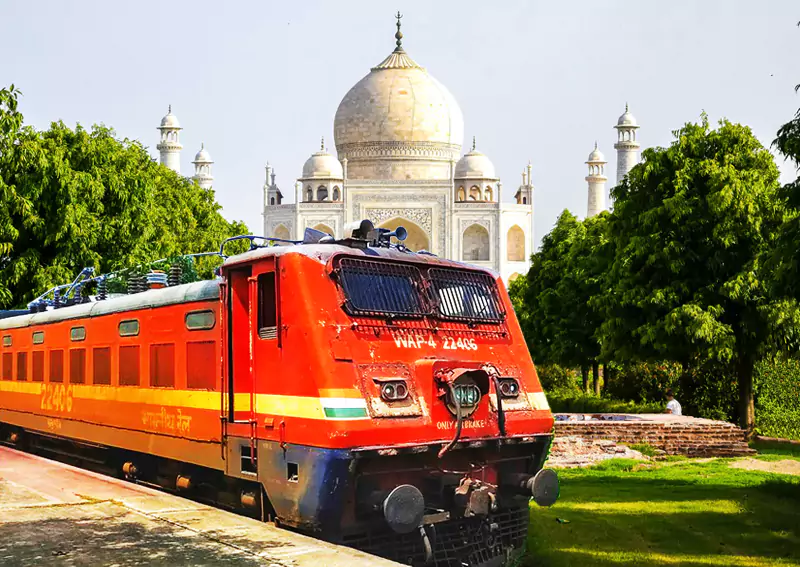
The Delhi–Agra stretch shows off India’s fastest daytime trains.
- Distance: About 200 km
- Fastest train: Gatimaan Express (often around 8:00–8:10 AM from Delhi side)
- Typical journey time: Around 1.5–2 hours
- Usual classes: AC Chair Car, Executive Chair Car
- Approximate fares in 2026: Roughly ₹400–₹1,200 depending on class and quota
Trains usually depart from Hazrat Nizamuddin or New Delhi stations and arrive at Agra Cantt, which lies a short taxi or auto‑rickshaw ride from most hotels and the Taj Mahal area. Premium services often include tea, breakfast, and bottled water in the ticket price, which helps if you travel straight into sightseeing.
Agra to Jaipur by Train
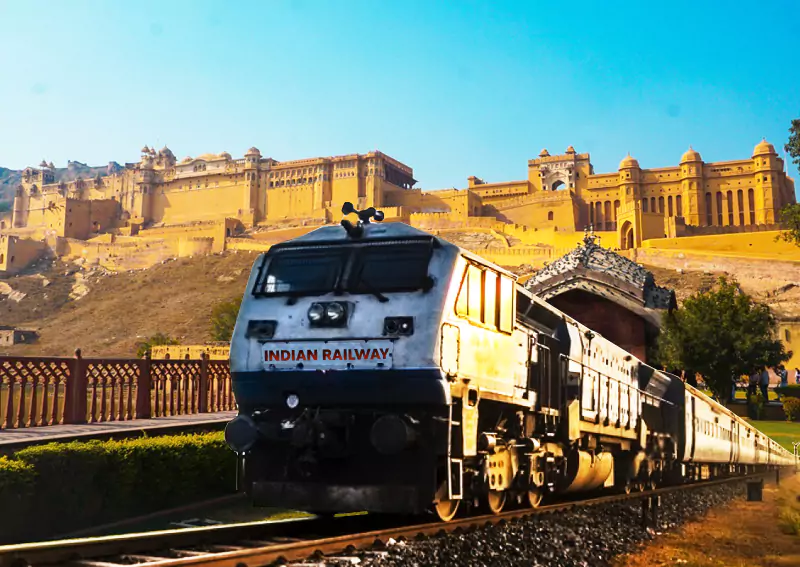
There is no single “flagship” train here, but several express options connect Agra and Jaipur during the day.
- Distance: Around 240 km
- Typical journey time: About 4–5 hours on express services
- Usual classes: AC Chair Car, AC 2‑tier, AC 3‑tier on longer‑distance trains
- Approximate fares: Roughly ₹500–₹1,500 depending on train and class
You depart from Agra Cantt and arrive at Jaipur Junction, which sits close to the city centre, with easy access to cabs, autos, and app‑based taxis. Reclining seats and air‑conditioning make the ride comfortable enough to count as a “moving rest” between sightseeing days.
Jaipur to Delhi by Train
Jaipur and Delhi link by several fast daytime trains, including Shatabdi types and other superfast services.
- Distance: Around 260 km
- Typical journey time: Around 4–5 hours
- Usual classes: AC Chair Car, higher‑end AC classes on some trains
- Approximate fares: Similar to Agra–Jaipur, roughly ₹500–₹1,500
Trains generally arrive into New Delhi or Delhi Cantonment, and you can use the metro, taxis, or app cabs to reach hotels or the airport. Evening departures from Jaipur let you maximise your last sightseeing day and still reach Delhi for a late dinner.
Pros of Train Travel
Travelling by rail between Delhi, Agra, and Jaipur works very well if you plan ahead and travel light.
- Typically cheaper than a private car over the same distance, especially for solo travellers and couples.
- Faster on Delhi–Agra than driving, thanks to high‑speed corridors used by trains like Gatimaan Express.
- Air‑conditioned coaches, assigned seats, and included meals on premium trains increase comfort.
- Less affected by highway traffic, toll queues, or city congestion.
- Lower environmental impact per passenger compared to a private car.
Cons of Train Travel
Trains also bring some friction points that you should factor into your plan.
- Need to arrive early at sometimes chaotic stations for security and platform changes.
- Fixed departure times limit spontaneous stops and side trips.
- Popular trains and classes can sell out days or weeks in advance in peak season.
- You must handle your luggage through crowds and up/down stairways.
Who Should Choose Trains?
Consider trains as your primary mode if you:
- Travel solo or as a couple and want to keep transport costs low.
- Can travel with smaller, wheeled luggage or backpacks.
- Prefer fixed schedules and do not mind using local cabs at each end.
- Enjoy watching rural landscapes and towns roll past from a window seat.
Private Car with Driver: Flexible, Comfortable, and Ideal for Groups
For many Golden Triangle visitors—especially families, small groups, or first‑timers—a private car with driver offers the most relaxed way to move between Delhi, Agra, and Jaipur. You travel door‑to‑door, choose your departure times, and stop for meals, photos, and lesser‑known spots with ease.
In 2026, typical quotes from established operators for a 5‑day Golden Triangle circuit in an air‑conditioned sedan or SUV fall in the range of roughly ₹18,000–₹25,000 for the vehicle and driver, excluding monument entry fees and most meals. Exact numbers depend on vehicle category, fuel prices, tolls, and inclusions such as parking and driver accommodation.
Delhi to Agra by Car
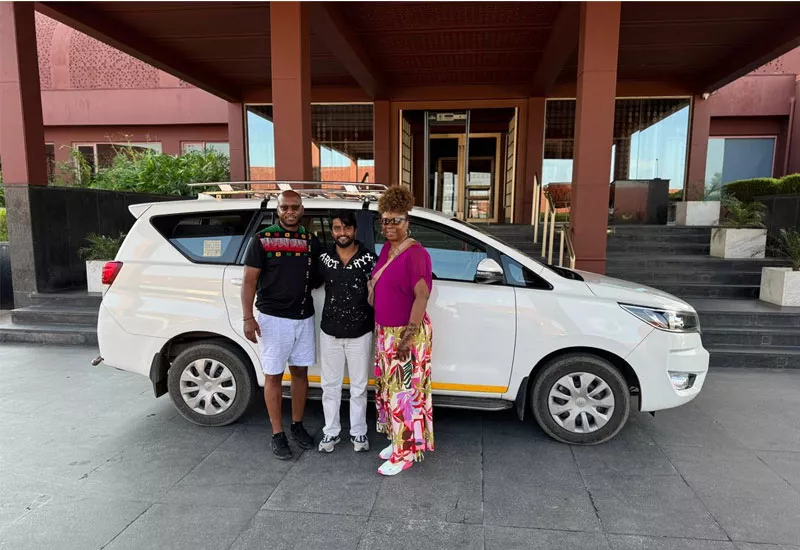
Driving from Delhi to Agra has become much smoother thanks to the Yamuna Expressway and upgraded approach roads.
- Distance: About 200–220 km depending on pickup point
- Typical journey time: Around 3–4 hours in normal conditions
- Route: City exit roads to NH44 and then the Yamuna Expressway
- Tolls: You pay expressway tolls via FASTag or cash; many operators include this in your package
Along the way, you can stop at clean highway restaurants and service areas that serve North Indian vegetarian and non‑vegetarian meals, snacks, and coffee. Many drivers know reliable “dhabas” and modern food plazas that cater to foreign travellers.
Agra to Jaipur by Car
The Agra–Jaipur run is where a car really shines if you want to stop at Fatehpur Sikri or Bharatpur Bird Sanctuary.
- Distance: Roughly 240–260 km, depending on detours
- Typical journey time: About 4–5 hours of drive time
- Common route: National Highway corridors linking Agra to Jaipur via Bharatpur and Dausa
You can pause at Fatehpur Sikri, a UNESCO‑listed former Mughal capital, for a 1–2 hour visit without juggling train timetables. You can also choose a short side trip into Keoladeo National Park in Bharatpur if you want a birding break between forts and palaces.
Jaipur to Delhi by Car
The Jaipur–Delhi highway has seen ongoing upgrades, which improves travel time compared to earlier years, though some congestion can still occur near cities and toll plazas.
- Distance: Around 260–280 km depending on your Jaipur hotel and Delhi drop‑off
- Typical journey time: Around 5–6 hours in 2026
- Route: National Highway 48, a key corridor with stretches of expressway‑like conditions
Starting early in the morning or after peak hour reduces the risk of getting stuck near Gurgaon or Delhi, especially on weekdays. Many drivers schedule refreshment stops every two to three hours to keep everyone comfortable.
Pros of a Private Car
A car with driver offers flexibility and comfort that trains and flights cannot match.
- True door‑to‑door travel between airports, stations, and hotels.
- Full control over departure times, meal stops, and side trips.
- Easier handling of multiple suitcases, strollers, or camera gear.
- More relaxed experience for families, older travellers, or anyone nervous about train stations.
- One driver stays with you over several days, which adds continuity and local insight.
Cons of a Private Car
Driving the Golden Triangle also brings trade‑offs.
- Higher overall cost than trains if you travel alone or as a couple.
- Exposure to city traffic, honking, and occasional delays due to construction.
- Long sitting periods of 4–6 hours on travel days.
- Need to vet operators for safety standards, vehicle condition, and licensing.
Who Should Choose a Private Car?
A car and driver usually works best for:
- Families or small groups who can split the cost across 3–6 people.
- First‑time visitors to India who want one point of contact and minimal logistics stress.
- Travellers who want to stop at Fatehpur Sikri, Bharatpur, village markets, or viewpoints on the way.
- Photographers or history buffs who prefer flexible timing at each stop.
Flights Between Delhi and Jaipur: Use Only When Time Is Tight
Commercial flights in the Golden Triangle currently cover only the Delhi–Jaipur leg, as Agra’s airport sees primarily limited or no regular commercial services for tourists. Airlines such as Air India and other carriers operate several daily flights, with schedules and prices fluctuating by season and demand.
Delhi to Jaipur by Air
Flying can save time if you travel directly between the two state capitals or connect onward to another region of India.
- Flight time: Around 45–60 minutes in the air
- Door‑to‑door time: Usually around 3–4 hours after adding check‑in, security, and city transfers
- Typical fare range in 2026: Often around ₹2,500–₹5,000 per person one way, depending on how early you book and which airline you choose
You depart from Delhi’s Indira Gandhi International Airport, which sits on the southwestern edge of the city, and arrive at Jaipur International Airport, roughly 30–45 minutes from most central hotels. Metro, taxis, and app cabs connect both airports to central areas.
Pros of Flying
Flying between Delhi and Jaipur helps in specific scenarios.
- Saves time when you combine the leg with an international arrival or departure.
- Reduces fatigue on itineraries where you already have several long drives.
- Provides an option for travellers who strongly prefer air travel over road or rail.
Cons of Flying
In many Golden Triangle itineraries, flights add complexity without saving much net time.
- Does not cover Agra, so you still need a train or car between Delhi and Agra or Jaipur and Agra.
- Check‑in times, security queues, and airport transfers reduce time savings.
- Fares can spike around holidays, festivals, and weekends.
- Baggage limits and cabin rules complicate travel with large bags or shopping.
Who Should Choose Flights?
Consider flights only if you:
- Need to jump quickly between Delhi and Jaipur as part of a larger India or business trip.
- Land or depart internationally from Delhi on the same or next day.
- Absolutely want to minimise your time on highways.
For most leisure‑focused Golden Triangle journeys, trains or cars offer better value and a more integrated experience.
Head‑to‑Head: Train vs Car vs Flight
The table below summarises typical 2026 times and rough cost patterns for a mid‑range traveller. Values vary by exact train, vehicle type, airline, and booking window, but this gives a useful comparison baseline.
| Route | Mode | Typical Time (one way) | Typical Cost per Person* | Key Advantage |
|---|---|---|---|---|
| Delhi → Agra | Train | 1.5–2 hours | Low–moderate | Fastest and budget‑friendly |
| Delhi → Agra | Car | 3–4 hours | Moderate–high (cheaper in groups) | Flexible stops and door‑to‑door travel |
| Agra → Jaipur | Train | 4–5 hours | Low–moderate | Good value if you skip stops |
| Agra → Jaipur | Car | 4–5 hours (plus sightseeing) | Moderate–high (cheaper in groups) | Easy side trip to Fatehpur Sikri |
| Jaipur → Delhi | Train | 4–5 hours | Low–moderate | Comfortable AC coaches |
| Jaipur → Delhi | Car | 5–6 hours | Moderate–high | Flexible departure and route |
| Jaipur → Delhi | Flight | 3–4 hours door‑to‑door | Moderate–high | Handy for tight schedules |
Which Option Wins for Different Travellers?
You rarely have a single “best” way to travel the entire Golden Triangle, because different legs favour different modes. Instead, think in terms of your priorities and mix accordingly.
Choose Trains If You:
- Want the fastest Delhi–Agra connection and a lower overall transport budget.
- Prefer not to deal with long highway drives or Indian city traffic.
- Pack relatively light and feel comfortable navigating stations with basic preparation.
Choose a Private Car with Driver If You:
- Travel as a family, couple with lots of luggage, or group of friends.
- Want a relaxed, door‑to‑door experience with minimal logistical thinking.
- Plan to visit Fatehpur Sikri, Bharatpur Bird Sanctuary, or smaller towns along the route.
Choose Flights If You:
- Need to link Delhi and Jaipur quickly to meet an international flight or a meeting.
- Have only a brief window to visit Jaipur from Delhi.
Best Hybrid Combination
Many experienced travellers now use a hybrid pattern along this route.
- Train from Delhi to Agra on a fast morning service.
- Private car from Agra to Jaipur, with a stop at Fatehpur Sikri or Bharatpur.
- Train or flight from Jaipur back to Delhi at the end of the loop.
This approach combines speed, flexibility, and cost‑efficiency while still giving you plenty of control over your pace.
Typical 5‑Day Golden Triangle Transport Plans
Once you know the strengths of each mode, you can plug them into a real itinerary.
5‑Day Trip with Private Car
- Day 1: Arrive in Delhi, explore a few key sights, then drive to Agra in the afternoon or evening.
- Day 2: Visit the Taj Mahal at sunrise, tour Agra Fort, then drive to Jaipur with a stop at Fatehpur Sikri.
- Day 3: Explore Jaipur’s forts and viewpoints.
- Day 4: See Jaipur’s old city, observatory, and markets; depart by car for Delhi in the late afternoon.
- Day 5: Buffer day in Delhi for shopping, museums, or onward flights.
This pattern maximises flexibility, reduces station stress, and suits families or first‑time visitors.
5‑Day Trip with Emphasis on Trains
- Day 1: Take a morning train from Delhi to Agra; visit the Taj Mahal in the afternoon.
- Day 2: Tour Agra Fort in the morning and catch an afternoon train to Jaipur.
- Day 3–4: Explore Jaipur’s forts, palaces, and markets at an easy pace.
- Day 5: Travel back to Delhi by train for onward connections.
This approach works particularly well for budget‑minded solo travellers and couples who enjoy independent movement and do not mind using taxis at each end.
Must Read:
Practical Tips for Any Mode in 2026
Regardless of how you choose to travel between Delhi, Agra, and Jaipur, a few universal tips will make your journey smoother.
- Book important trains and flights as early as you can, especially between October and March and around major festivals.
- Travel early in the day to avoid heavy traffic and midday heat, particularly on road journeys.
- Keep luggage manageable; even with a car, lighter bags ease hotel check‑ins and monument visits.
- Use trusted apps and official websites for booking and payments; avoid handing your phone or card details to unofficial agents.
- Share your live location with a trusted contact at home or your hotel when taking late‑evening transfers.
If you travel as a woman or with children, consider a private car or premium train classes for added comfort, predictability, and easier supervision of bags and kids.